Galileo Had His Stuff Together (And I Do Not)
Dear Magicians,
I told a friend last week I was thinking about writing another book.
He looked at me like I’d announced I was going to free solo Half Dome in my underwear
“Are you crazy?” he said. “You remember how long it took last time? How much it cost you—time, sanity, everything?”
He’s not wrong.
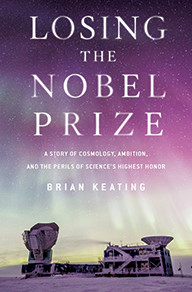
My first book, Losing the Nobel Prize, hurt. Twenty revisions. Years of delayed gratification. That voice in your head saying, What if no one reads this?
But here’s the mistake almost everyone makes: they think the book is the hard part.
It isn’t.
The $150 Million Pencil
There’s a famous story by Leonard Read a guy who tried to make a pencil from scratch.
Not assemble it—create it.
Cut the wood. Mine the metal. Tap rubber trees for the eraser. Dig up graphite. Refine resins. Mix paint.
The punchline: no one person can really “make” a pencil. Modern life is too complex. Everything depends on invisible networks of other people.
Now swap the pencil for a scientific paper.
I’m an experimental cosmologist. When my colleagues and I write a paper for something like the Simons Observatory, our “pencil” is a $150 million telescope.
Twelve years to design, build, deploy, and collect data. Hundreds of people. Thousands of decisions.
The paper is just the sharpened tip of that effort.
And yet when I say, “I might write another book,” people act like that’s the insane project.
Nope.
Why Papers Cost More Than Books
A scientific paper is not just words on a page.
It’s not free, even in the fortunate case where it’s Open Access and not published in a fly by night predatory journal.
It’s an audit of your life.
You’re not only reporting results; you’re defending years of work. You’re putting your students’ and collaborators’ effort on the line. Your own reputation, too.
The process is slow torture:
Build.
Collect data.
Analyze.
Argue.
Write.
Submit.
Get refereed.
Rewrite.
Resubmit.
Wait.
My most cited BICEP paper has around 2,000 citations. In my world, that’s solid.
But a book can reach tens of thousands of readers who will never set foot in a lab.
Here’s the paradox: the scientific work is harder, longer, and more complex. Yet the book feels more terrifying.
Because a paper says, “Here’s what we did.”
A book says, “Here’s who I am.”
Big difference.
The Lone Genius Lie
We still love the myth of the lone genius.
The scientist in the lab.
The writer in the cabin.
The artist in the studio.
Just one heroic brain against the universe.
Reality is messier.
Nothing serious gets built alone. Not telescopes, not papers, not even books. Editors, agents, early readers—they’re all part of the system. The pencil is a miracle not because it’s simple, but because it’s the product of a thousand invisible hands. So is a scientific paper. So is most of your life, if you’re honest about it. Look at your own career: it’s a patchwork of your choices, other people’s help, accidents, lucky breaks, and a few disasters.
You’re not nearly as self-made as you think.
Neither am I.
Regret as Data
When I look back, I see a trail of unfinished stuff.
Half-written papers. Abandoned book drafts. Experiments that fizzled. Projects that quietly died when reality failed to cooperate with my optimism.
For a long time, I took this as proof that I was failing. Not disciplined enough. Not smart enough. Not whatever-enough.
But regret has structure.
It’s information.
Every failed paper, every dead book, every broken idea—these aren’t just scars. They’re data points. They show where your limits are right now. Where your blind spots live. Where ambition outran ability.
Unpleasant? Yes.
Useful? Very.
Sometimes the point of a project isn’t to succeed. It’s to map the edge of what you can currently do so you can push it next time.
The Chicken Sandwich Problem
There’s another story—about a guy who tried to make a chicken sandwich from scratch.
He raised the chicken. Grew the wheat. Made the butter. Harvested the lettuce.
Six months. A pile of money. One sandwich.
It was… okay.
The lesson is obvious: some things only make sense because we stand on top of other people’s work.
The pencil.
The sandwich.
The telescope.
The paper.
The book.
None of them are solo acts.
Yet many of us insist on pretending we should do everything alone, then feel like failures when we can’t.
That’s not noble. It’s just unrealistic.
So… Another Book?
Will I write another one? I don’t know.
But the next time someone tells me I’m crazy for even thinking about it, I’ll think about the pencil. I’ll think about the $150 million, twelve-year “paper” that’s really a monument to collective effort and invisible labor.
And I’ll ask myself—and you:
What are you building that you can’t see yet?
Whose unseen hands are already helping you?
What “pencils” are you trying to make entirely from scratch?
And what would happen if you finally stopped pretending you had to do it all alone?
Send me an email — I read every one, even if I don’t have time to reply to each one.
Until next time, have a M.A.G.I.C. Week,
Brian
Appearance
Spotify just released their 2025 Wrapped & The Into the Impossible Podcast was in the Top 1% of videos on Spotify!0
Into the Impossible is also one of the top Marathon Shows, Talked About Shows, and Most Shared Shows for 2025.
With the #10 Top spot on charts and 2.1K Top Fans, I would like to thank you for all your support!
Join us here!
Genius
Geniuses suspect cosmic rays—likely from a distant supernova—triggered the JetBlue A320’s sudden plunge.
Space radiation specialist Clive Dyer argues high‑energy particles from a supernova caused microelectronic upsets that led to the October Cancun‑to‑Newark incident, injuring about 20 passengers and forcing an emergency landing in Tampa.
While Airbus pointed to intense solar radiation affecting the 20‑year‑old jet’s navigation computer, Dyer says the Sun’s levels weren’t high enough, making extragalactic cosmic rays the more plausible culprit.
Image
What is the Small Magellanic Cloud? It has turned out to be a galaxy. People who have wondered about this little fuzzy patch in the southern sky included Portuguese navigator
Ferdinand Magellan his crew, who had plenty of time to study the unfamiliar night sky of the south during the first circumnavigation of earth in the early 1500s. As a result, two celestial easily visible for southern hemisphere skygazers are now known in Western Culture as the Clouds of
📸 Mike Adler
(Not affiliated Mike has a “buy” link on the upper right so if you would like any of the images on the site use the “buy” link. It will send Mike an email with your request.)
Conversation
In this episode, I sit down with evolutionary biologist and Dark Horse Podcast host, Bret Weinstein, to unpack one of humanity’s most urgent and unsettling questions: Are we living through the next phase of human evolution — and is it happening too fast for biology to keep up?
SPONSORED BY ALIGNERR
WANTED: Developers and STEM experts!
Get paid to create benchmarks and improve AI models.
Sign up for Alignerr using my exclusive link.
Upcoming Episode
Rebecca Goldstein will be on The INTO THE IMPOSSIBLE Podcast soon.
Her new book The Mattering Instinct: How Our Deepest Longing Drives Us and Divides Us is a rich account of into the psychological and philosophical roots of why humans seek meaning, belonging, and moral purpose — offering a fresh synthesis of evolutionary theory, ethics, and existential inquiry.
Her talent for blending rigorous intellectual insight with deeply human concerns — across works such as Plato at the Googleplex, 36 Arguments for the Existence of God, and now this new book — makes her uniquely equipped to challenge and expand our understanding of meaning, morality, and identity.
What would you like me to ask her on the show?
Submit your questions here!