The creed hiding in your favorite physics theory
Dear Magicians,
A survey just asked 1,675 physicists a simple question. Which theory best unites quantum mechanics and gravity? String theory won.
Sort of. It came in first at 18.9 percent, which means it lost to “no opinion” at 28.7. Forty years of work, no experiment, and the field’s favorite idea got beaten by a shrug.
I find this hilarious. Mostly because I’ve spent my career insisting that physics is the one discipline where you don’t get to just believe things. You measure them. Show me the experiment or get out of my telescope.
And then I read surveys like this one and remember that physicists are people. People believe in bundles.
Here’s the part that stopped me cold.
The authors found that physicists who prefer string theory also tend to believe black hole information escapes through Hawking radiation. The correlation was 7 sigma. For non-physicists, that’s the statistical equivalent of winning a typical lottery jackpot… twice.
Now, there’s an innocent explanation. The math that says information gets out mostly lives inside the string theory toolkit. So picking one nudges you toward the other. Fair enough.
But notice what’s happening. Your opinion on one untested idea predicts your opinion on a second untested idea. Not because the universe linked them. Because you did.
The authors, Zeus bless them, called it “patterns of coherence in respondent worldviews.” Which is the most polite way I’ve ever seen someone write the word “creed.”
This shows up everywhere once you look. For example, the physicists who explain dark matter with a multiverse also tend to pick the Many Worlds version of quantum mechanics, where reality splits into copies every time you measure something. Two flavors of “there are infinite unobservable universes.” Same people. Every time.
Or take the fine-tuning question. Asked why the constants of nature seem suspiciously perfect for life, 8.9 percent of professional physicists answered “an intelligent designer.” In a physics survey. I’m not mad. I’m taking notes. And it dovetails perfectly to this week’s conversation with the Discovery Institute’s (ID backwards, get it?) Dr. Stephen C. Meyer.
Now, I can’t be sanctimonious. I have aesthetic preferences in physics that I dress up as rigorous judgments. I find certain theories beautiful and certain ones ugly, and I have absolutely caught myself believing the beautiful ones a little harder than the evidence allows. Beauty is a fantastic muse and a terrible witness.
The honest move isn’t pretending you have no creed. You do. We all do. The honest move is knowing which beliefs you’ve earned with data and which ones you’ve just grown fond of.
Supersymmetry was a beautiful idea. The Large Hadron Collider tested it and it lost, and support quietly drained away. That’s the system working. A wager placed, a wager lost.
String theory never placed the bet. So it can’t lose. It just sits at the top of the poll, undefeated and unconfirmed, like a champion who never entered the ring.
If we can’t tell the difference between our best theories and our favorite ones, what exactly have we been measuring all this time?
Until next time, have a M.A.G.I.C. Week,
Brian
Appearance
What if the Big Bang wasn’t the beginning — just a chapter in something far stranger?
I sit down with Gleb Solomin to tackle the biggest questions in cosmology: how something emerged from nothing, whether the multiverse is real (and provable), what dark energy is doing to the fabric of spacetime, and whether reality itself is as stable as we assume.
If you’ve ever wondered what existed before the Universe — this one’s for you.
Watch the conversation here.
Genius
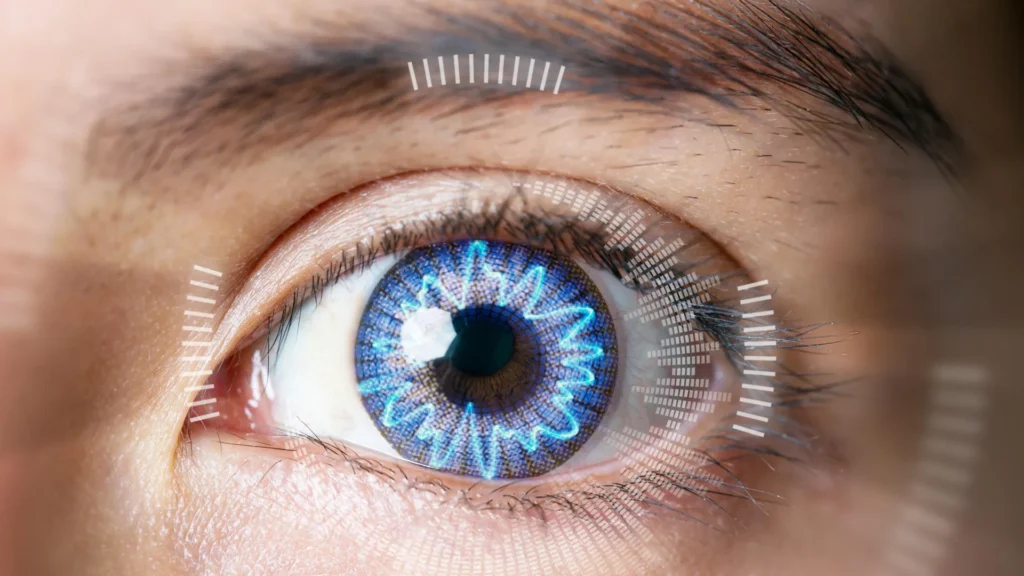
GENIUS Action: The Elegance of Not Cutting
Researchers at Occidental College and UC Irvine developed electromechanical reshaping (EMR): mild electrical pulses through a platinum contact lens soften the cornea, reshape it in about a minute, then let it harden in the new configuration. Ten of twelve rabbit eyes corrected successfully, matching LASIK timeframes with no incisions and no tissue removal. Human trials are years out, but the cost could be far lower.
LASIK corrects vision by ablating tissue and, in its modern bladeless form, by slicing a corneal flap with an ultrafast laser. Effective, but irreversible. You remove what’s in the way. EMR does the opposite: it softens the existing structure, guides it to a new shape, then lets it set. Nothing is destroyed. This is a real metaphor for change management. The brute-force fix removes the flawed part but burns your options with it. The elegant fix creates conditions where the system settles into a better equilibrium on its own, structure intact. Ask yourself whether you’re trying to laser away a bad habit or building the conditions where a better pattern can quietly take hold.
This connects to past guest Donna Strickland. Her Nobel-winning chirped pulse amplification (for example, the ultrafast pulses that cut the corneal flap in bladeless LASIK, or the high-intensity beams now standard in laser machining) is the very cutting that EMR sidesteps. We covered exactly how CPA tamed petawatt-scale light in my conversation with her [link to the Strickland episode]. Worth noting she sits a stone’s throw from this in another sense: her CPA made laser eye surgery precise, and the next move may be to stop using the laser on the eye at all.
Image
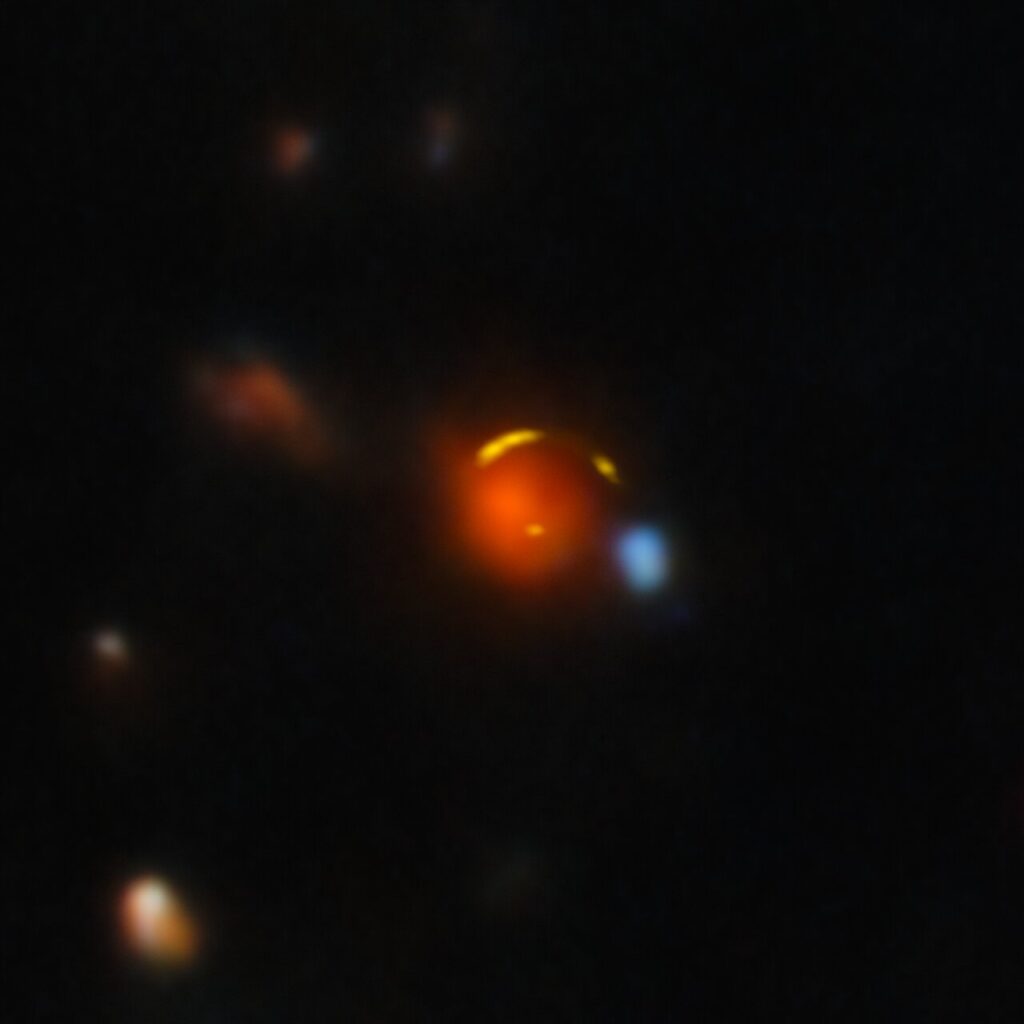
A Cosmic detective story.
Meet “Shadow Blaster,” a distant star-forming galaxy whose light has traveled about 11 billion years to reach us. In the image, the galaxy appears as golden arcs, because a nearer foreground galaxy bends and magnifies its light through gravitational lensing. But the real magic is invisible: astronomers think Shadow Blaster may be the source of a high-energy neutrino detected by the IceCube Neutrino Observatory in Antarctic ice in 2021.
Neutrinos are sometimes called ghost particles because they barely interact with matter. Trillions pass through you constantly, utterly indifferent to your bones, coffee, ambitions, and unread emails. Detecting one is already a triumph. Tracing one back across cosmic time to a galaxy in the young universe is the astrophysical equivalent of catching a whisper fired from another epoch.
The twist: scientists often expect the most energetic cosmic particles to come from black holes or violent jets. But Shadow Blaster may be different. Its compact, gas-rich core, only about 1,500 light-years across, appears to be an extreme star-forming region, dense enough to act as a natural particle accelerator. In other words, this may be a galaxy where furious stellar birth, not a monster black hole, helped launch one of the universe’s most elusive messengers toward Earth.
Why it’s genius: The image shows light bent by gravity, but the story is about something almost impossible to see: a neutrino that crossed most of cosmic history and finally revealed where it may have come from. A golden arc on the sky becomes a return address for a ghost.
Read the Sky & Telescope story:“Shadow Blaster” Galaxy Might Have Sent High-Energy Neutrino to Earth
Conversation
Latest on Into The Impossible
Can AI prove that minds can’t be reduced to matter?
Stephen Meyer — Cambridge PhD, philosopher of science — thinks model collapse is the argument materialists can’t answer.
I’m not convinced, and he came prepared: the Oklo reactor, the Wheeler-DeWitt equation, the junk DNA prediction, and whether intelligent design makes real predictions or just clever retrodictions.
Meyer sees the traps coming. What he does with them is worth watching.
Advertisement

By popular demand, and for my mental health 😳, I am starting a paid “Office Hours” where you all can connect with me for the low price of $19.99 per hour. I get a lot of requests for coffee, to meet with folks one on one, to read people’s Theories of Everything etc. Due to extreme work overload, I’m only able to engage directly with supporters who show an ongoing commitment to dialogue—which is why I host a monthly Zoom session exclusively for patrons in the $19.99/month tier.
It’s also available for paid Members of my Youtube channel at the Cosmic Office Hours level (also $19.99/month). Join here and see you in my office hours!
Advertisement

$14,000+ in AI tools. One card. $199
Unlock $14,000+ in AI tools, credits, templates, perks and partner benefits with the AI Executive’s Pass. Built for operators, founders and leaders who want to move faster with AI.