AI Made Me Young Again
Dear Magicians,
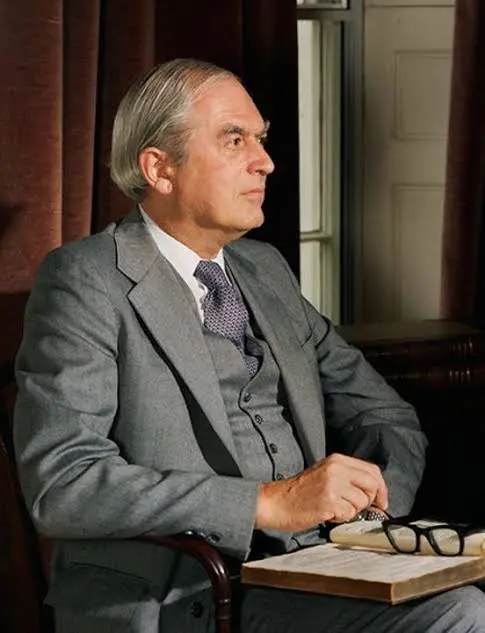
Peter Medawar, one of my favorite Nobel laureates, once wrote something that is more true in the age of AI: “No working scientist ever thinks of himself as old.” This is an appealing sentence for anyone, like me, who has begun making small involuntary noises while getting out of a chair. Medawar explains why: the scientist “enjoys the young scientist’s privilege of feeling himself born anew every morning.”
I have been thinking about that sentence because this week I received nearly unlimited free access to Claude for an oddly specific reason. I am a professor and the principal investigator of a research lab, which apparently is enough to convince someone that I should have nearly unlimited artificial super intelligence.
I already had access to Claude and have been paying more than $100 a month for it, despite becoming increasingly unsure that it is the right tool for much of my research. As an editor, however, it is extraordinary. It sits there at all hours, ready to tell me that a sentence I have loved for three days is unnecessary.
The interesting part of the new arrangement is that I can give access to my students. I had recently picked up a printed copy of his autobiography, Memoirs of a Thinking Radish. Yes, that is the actual title, and already considerably better than anything I have read in a long time, including much of my own work.
I opened the book to a random page while talking with one of my kids, mostly to prove that a great scientist could also be funny. Knowing me his whole life, he had his doubts about that proposition. He was a Nobel Prize-winning immunologist who also had an unusual view of scientific aging. Scientists may accumulate gray hair, administrative responsibilities, and stories about experiments performed before their students were born while still believing that the interesting work remains ahead of them.
That is where AI gives Medawar’s idea a strange new literalness. I can wake up tomorrow and attempt things in Claude that yesterday would have required far more time, more specialized training, or an embarrassing email to someone twenty years younger than me. I can enter an unfamiliar literature, write code in a language I barely know, or push an analysis farther before asking someone else to rescue me.
One of the quiet problems of becoming a senior scientist is that experience grows while technical flexibility can shrink. The frontier keeps moving, and entire fields can appear while you are answering email or trying to remember which institutional training module you have failed to complete. AI can soften this problem by giving an experienced researcher a patient guide to whatever happened while he was in a faculty meeting.
Claude doesn’t sigh when I ask what a software package does. It does not seem surprised that I have never used Git properly, and it will explain the same concept repeatedly without forming a private Slack channel about you. It can restore some of the intellectual freedom of being a beginner. It also allows you to keep your dignity.
Medawar placed a condition on his own refusal to grow old. He wrote that there would be an “unanswerable argument” for his retirement if remaining in his position made him “an obstacle to the advancement of others.” That sentence becomes increasingly uncomfortable as one acquires tenure, seniority, and a growing ability to occupy meetings indefinitely.
Academic seniority comes with extraordinary privileges, including access to funding, institutions, laboratories, networks, and increasingly powerful technologies. It also makes some of us surprisingly difficult to remove, which may be a feature of tenure or simply one of academia’s longest-running administrative oversights. Medawar himself joked about this after illness confined him to a wheelchair: they simply couldn’t get rid of him.
His refusal to equate physical decline with intellectual retirement was more than a clever line. Medawar suffered a severe stroke in 1969 and stepped down as director of the National Institute for Medical Research in 1971, yet he continued scientific work for years afterward. Memoirs of a Thinking Radish appeared in 1986, after further strokes, and he died the following year on October 2, 1987.
So when Medawar wrote about feeling “born anew every morning,” he was writing late in life from considerable personal experience with aging and physical limitation. He had been given several persuasive reasons to think of himself as old. His response was to keep doing science while remaining alert to the possibility that staying too long could begin to cost someone else.
Medawar offers a refreshing clarification and rubric on how to live your life as a scientist : remain curious, remain useful, and notice when your position begins to narrow someone else’s possibilities. The privilege of remaining scientifically young becomes much more defensible when you use it to make other scientists younger too.
Be born anew every morning. Then make sure the people coming after you have the same opportunity, preferably with better code and fewer committee assignments. If they manage to outrun you by lunch, the day has probably gone rather well.
Till next week, have a magic week.
Brian
Appearance
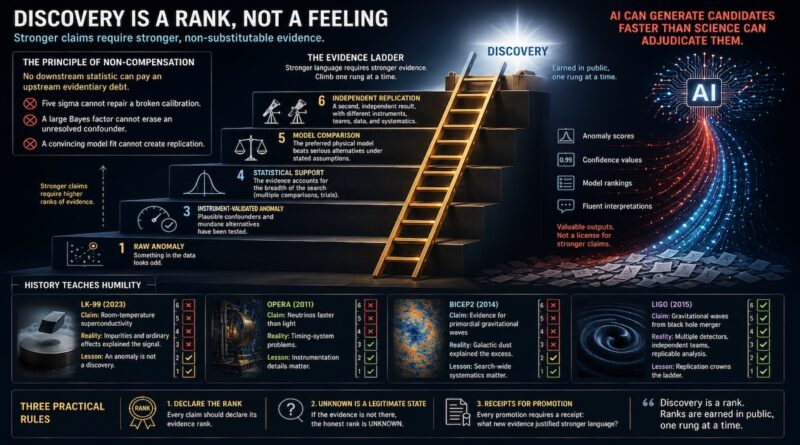
Burak Oktenli argues that scientific discovery should be treated as a rank earned through evidence, not as excitement or statistical significance alone.
As I wrote about in my first book, Losing the Nobel Prize, BICEP2 is a canonical example of this phenomenon. In 2014, it detected excess B-mode polarization in the cosmic microwave background, initially interpreted as evidence of primordial gravitational waves from cosmic inflation. The signal itself was real, but Galactic dust could produce a similar pattern. Later joint analysis with Planck data showed evidence that dust explained much of the signal, leaving no statistically significant detection of primordial gravitational waves.
The lesson is that a real anomaly does not automatically justify a discovery claim. Instrument validity, confounders, statistical treatment, alternative models, and replication must all be checked. The author extends this warning to AI, which can rapidly generate confident interpretations before the evidence chain is complete.
Genius

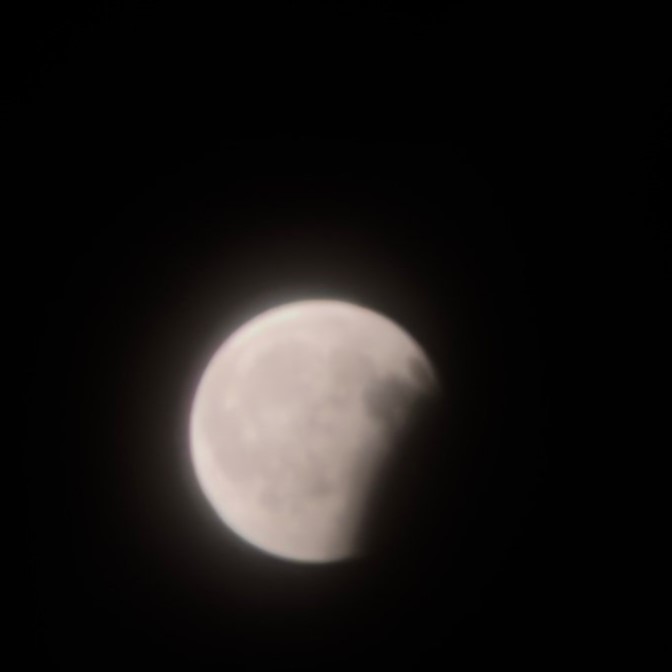
I was able to capture the lunar eclipse that occurred last week. It made me think of Christopher Columbus and what he did with the eclipse that was nothing short of genius.
Image
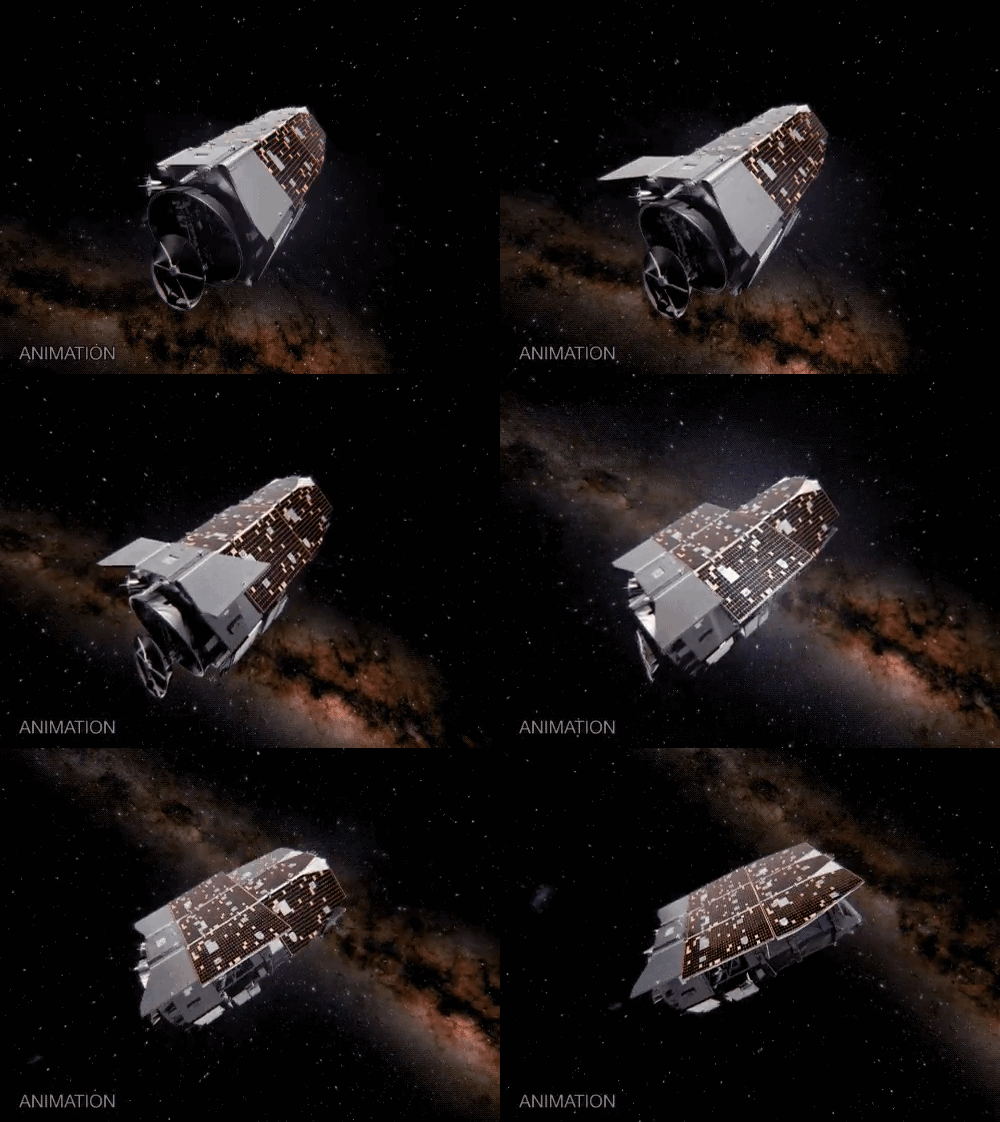
Beating swords into plowshares- NASA just launched a telescope whose 2.4-meter mirror was originally built to spy on Earth.
In 2012 the National Reconnaissance Office donated two unused Hubble-sized telescope assemblies that had been sitting in a warehouse after a canceled spy-satellite program. NASA took one, pointed it the other way, and built an entire new observatory around it.
The result is Roman: same mirror size as Hubble, but a field of view more than 100 times larger. It will survey the sky in infrared looking for dark energy, map millions of galaxies, and hunt exoplanets with a coronagraph.
Today it lifted off on a Falcon Heavy and already deployed its solar arrays and sun shades. From classified reconnaissance hardware to cosmic survey machine in one donation.
The universe just got a very expensive second life.
Conversation
Latest on Into The Impossible
I brought two people into the same room who fundamentally disagree about whether we survive this.
Emad Mostaque co-founded Stable Diffusion and was the only AI CEO to sign the pause letter. Now, he admits he doesn’t know how a pause would actually work. Roman Yampolskiy coined the term “AI safety” and spent a decade proving superintelligence can’t be controlled. He thinks pausing is the only option left.
I set out to host a debate. What I got instead was more unsettling: two experts converging on how little anyone actually knows about controlling what we’re building. No paper. No patent. No prototype. Nobody has one.
We get into what “lobotomized” models really mean, why swarm intelligence might be the risk nobody’s watching, and the question that stuck with me long after we stopped recording: if there’s a 50% chance this wipes out civilization and you build it anyway, what are you actually doing?
Audio is live on Apple Podcasts and at briankeating.com/podcast.
Advertisement

By popular demand, and for my mental health 😳, I am starting a paid “Office Hours” where you all can connect with me for the low price of $19.99 per hour. I get a lot of requests for coffee, to meet with folks one on one, to read people’s Theories of Everything etc. Due to extreme work overload, I’m only able to engage directly with supporters who show an ongoing commitment to dialogue—which is why I host a monthly Zoom session exclusively for patrons in the $19.99/month tier.
It’s also available for paid Members of my Youtube channel at the Cosmic Office Hours level (also $19.99/month). Join here and see you in my office hours!