I kept citing a dead theory because everyone else did
Dear Magicians,
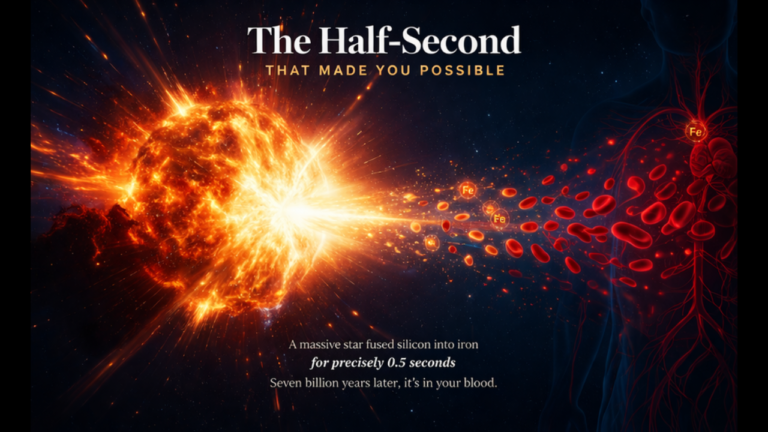
The Half-Second That Made You Possible
I was staring at a houseplant last Tuesday. Not because my Netflix subscription expired. But rather it caught my eye because I couldn’t stop thinking about iron. Specifically, the iron in my blood that used to be inside a star that died before our sun was born.
The plant was ordinary. Green leaves, probably overwatered. But here’s what stopped me: that plant’s chlorophyll molecule is nearly identical to my hemoglobin, except where my blood has iron at its center, the plant has magnesium. Same structure, different metal. Both essential. Both impossible without stars that exploded in half a second.
Let me explain why this matters more than your next grant application.
The Most Important Half-Second in Cosmic History
A massive star—eight to twenty times our sun’s mass—burns through its hydrogen for about seven million years. Seven million years of nuclear fusion, of converting hydrogen to helium, helium to carbon, carbon to oxygen, oxygen to silicon. Then something remarkable happens.
For precisely half a second, the star fuses silicon into iron.
Not approximately half a second. Not “roughly” half a second. Exactly. If this fusion lasted any shorter, insufficient iron would form to seed future planets with the heavy elements necessary for life. Any longer, and the universe would be nothing but iron—no silicon for rocks, no carbon for biology, no oxygen to breathe.
The timing is so precise it defies comprehension. Seven million years of stellar evolution culminating in half a second that determines whether complex life can ever exist. That’s one part in ten trillion. Try explaining that to your department’s tenure committee.
Your Blood Contains the Ashes of Dead Stars
When that half-second ends, the star collapses under its own gravity and explodes as a supernova. The iron—along with carbon, nitrogen, oxygen, calcium—gets blasted across light-years of space. Eventually, some of it condenses into new solar systems. Planets form. Oceans appear. And four billion years later, that iron ends up in your bloodstream, binding oxygen molecules so you can read this sentence.
The magnesium in that houseplant came from the same explosion. Same origin story, different biological pathway. Both essential for life as we know it. Both impossible without that precise half-second of stellar alchemy.
Think about that the next time you’re questioning your career trajectory.
The Design Question Nobody Answers
My students always ask the obvious question: “Does this prove the universe was designed for life?”
Here’s what I tell them: It proves something more interesting. It proves that the universe is capable of producing beings who can ask why the universe is capable of producing beings who can ask why. The timing isn’t just fine-tuned for iron production—it’s fine-tuned for consciousness to emerge and recognize the fine-tuning.
But design implies a designer, and that leads us somewhere physics can’t follow. What we can say is this: the same processes that created iron in distant supernovae also created the conditions for you to question your purpose. The universe isn’t just habitable—it’s comprehensible. That’s either the luckiest accident imaginable, or it suggests something deeper about the relationship between consciousness and cosmos.
Your Career is Not a Straight Line
That houseplant doesn’t know it’s using magnesium instead of iron. It just grows toward the light, following biological programming billions of years in the making. We have the same programming, but with an added feature: we can question our direction.
The iron in your blood took a seven-billion-year journey through space to reach you. Your career setbacks might be the equivalent of that half-second fusion—precisely timed destruction that creates the elements for your next iteration.
What if your current confusion about career path is actually the universe’s way of producing something that couldn’t exist through linear progression? What if your failures are heavy elements waiting to be distributed across your future projects?
When did I lose the ability to see destruction as creative force?
What Are You Walking Past?
That houseplant will never understand astrophysics. But it knows something I forgot for years: grow toward the light, use what’s available, don’t apologize for needing different elements than the plant next to you.
The iron in your blood connects you to cosmic processes beyond comprehension. The setbacks in your career might be connecting you to professional possibilities beyond your current imagination.
What elements are you refusing to fuse because the timing seems wrong? What supernova are you preventing because you’re afraid of the explosion?
The universe took seven million years to prepare for half a second that made you possible. How long are you willing to prepare for your own transformation?
Until next time, have a M.A.G.I.C. Week,
Brian
P.S. I share other life lessons from generous Nobel Prize winners in my newest book, Focus Like a Nobel Prize Winner. Please pick up a copy and if you already did, Thank you (and please leave a review)
Appearance
I was a guest on the Jordan Peterson Podcast. We got into the deepest question cosmology can ask — why does the universe exist at all, and why does that question hit people like a religious experience?
Here’s what we talked about: the way cosmology functions as the ultimate origin story, why it inevitably evokes existential and spiritual responses, and how modern fascination with UFOs, multiverses, and simulation hypotheses serves as a secular substitute for traditional creation narratives.
The core provocation: people who reject religion still can’t live without overarching metaphysical stories, so they reinvent creator-like intelligences — advanced civilizations, simulation architects — that deliver the explanatory comfort of a deity without the moral obligations.
Genius

🧟 Zombie Theories
In science, some theories are killed by data. Others are killed by data but refuse to lie down.
Researchers formally catalogued “zombie theories”—falsified frameworks that persist in textbooks, grant proposals, and clinical practice years after being empirically demolished. They survive because entire careers, institutions, and treatment protocols were built on them. Retracting the theory means retracting the people who built their work on it.
Science progresses, as Max Planck darkly observed, “one funeral at a time.” Maybe because these Zombie theories survive because Zombies don’t have funerals?? Anyway, the problem isn’t that scientists are corrupt. It’s that they’re human. Sunk costs feel real, even when the theory doesn’t. So my question to you isn’t whether there are zombie theories in your field. There are. The question is which ones you’re currently citing.
Image
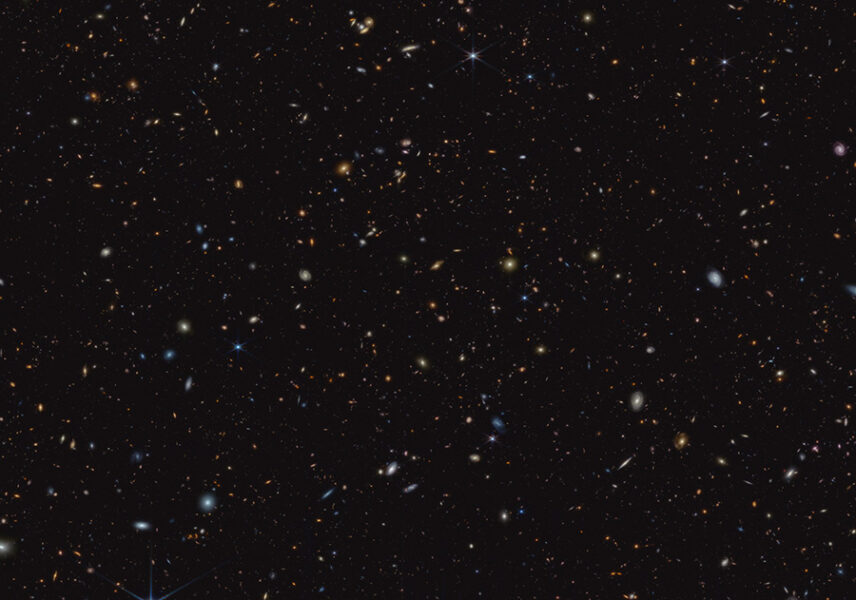
ASTERIS AI reveals 160+ hidden galaxies from the Cosmic Dawn — the universe’s first 500 million years.
A Tsinghua University team built an AI network that strips noise from JWST deep-field images, revealing features a full magnitude fainter than previous methods could detect — tripling the known galaxy count from that era. The visual: a JWST deep-field comparison, before and after ASTERIS processing, with dozens of faint red smudges emerging from what looked like empty black sky.
Like Zombie Theories, the galaxies were always there, hidden in the data, waiting for a tool that refused to accept the existing catalog as complete.
Conversation
Latest on Into The Impossible
Every field has its zombie theories — frameworks that should be dead but keep getting cited because too many careers were built on them. Planck said science advances one funeral at a time. I’ve been thinking about which funerals are overdue. This week I speak to Dr. Michael Wong, a revolutionary thinker who believes that, despite many, many funerals in physics since the creation of thermodynamics, we scientists missed an entire new law of nature — time’s second arrow, the title of his book.
What’s the zombie theory in your world — the idea everyone pretends still works? It doesn’t have to be science. It could be a management framework, a parenting philosophy, a diet protocol, an economic assumption. Reply and tell me which undead idea you’re done pretending to believe.
Channel members can watch it a day early — join here.
Advertisement

By popular demand, and for my mental health 😳, I am starting a paid “Office Hours” where you all can connect with me for the low price of $19.99 per hour. I get a lot of requests for coffee, to meet with folks one on one, to read people’s Theories of Everything etc. Due to extreme work overload, I’m only able to engage directly with supporters who show an ongoing commitment to dialogue—which is why I host a monthly Zoom session exclusively for patrons in the $19.99/month tier.
It’s also available for paid Members of my Youtube channel at the Cosmic Office Hours level (also $19.99/month). Join here and see you in my office hours!