Even Einstein’s Blunders Were Blunders
Dear Magicians,
Arthur C. Clarke once said, “Any sufficiently advanced technology is indistinguishable from magic.” In fact, that’s the origin of the name “Monday M.A.G.I.C. Messages”!
But here’s the thing Clarke didn’t say: any sufficiently honest scientist is indistinguishable from a student.
Yesterday was Galileo’s birthday — 462 years ago. This week I’ve been thinking about Galileo’s book The Assayer—his 1619 masterpiece of scientific rhetoric. In it, Galileo declares nature is written in the language of mathematics. Beautiful. Revolutionary. And also the same book where he got comets completely wrong.
Galileo insisted comets were atmospheric illusions—optical tricks of reflected sunlight. Tycho Brahe had already proven, through precise parallax measurements, that comets were celestial bodies far beyond the Moon. Galileo dismissed him anyway. Why? Partly because Tycho’s cosmological system wasn’t pure Copernicanism. Partly because Galileo was stubborn. Mostly because even geniuses are human.
Einstein made similar mistakes. He called the cosmological constant his “greatest blunder”—then dark energy resurrected it. He spent decades chasing a unified field theory while ignoring quantum mechanics. He dismissed gravitational waves as mathematical artifacts. LIGO proved him wrong in 2015.
The Stoics had a practice called dokimazein—assaying coins to test their authenticity. Merchants could hear the difference between real and counterfeit by the ring of the metal. We do the same with hundred-dollar bills, rubbing them, holding them to light.
But how often do we assay our own ideas with the same rigor?
The lesson isn’t that Galileo and Einstein were frauds. The lesson is that even the greatest minds require friction to find truth. The mistake isn’t being wrong—it’s refusing to test the coin.
Until next time, have a M.A.G.I.C. Week,
Brian
Appearance
Black Holes, Worm Holes, and the Origin of Everything
I recently joined James Altucher for a two-part conversation diving deep into the mysteries of the cosmos.
We covered:
• The Webb Telescope’s discovery of massive primordial black holes and what it means for our understanding of the universe
• Why space and time are inseparable in Einstein’s framework
• The strange relationship between gravity and time near massive objects
• The historical “ether theory” and how its failure led to relativity
• Whether wormholes could actually exist
• Why the speed of light is a fundamental limit
• The future of cosmology: hunting for primordial gravitational waves and the oldest signals from the Big Bang
Genius
“What Is The Question?”
Originally published in 2019, this paper resurfaced recently when Tim Ferriss recommended it in his newsletter. Professors Itai Yanai and Martin Lercher argue that discovery begins with better questions, not answers.
“The most interesting unknowns of science are unknown unknowns—gaps that we were not even aware of before chancing upon them.”
Tim Ferriss recently featured this paper. It’s worth your time.
Image
In 1971, Apollo 15 astronaut David Scott dropped a hammer and a falcon feather on the Moon — proving Galileo’s 400-year-old hypothesis that without air resistance, all objects fall at the same rate. The equivalence principle in action, on Galileo’s 462nd birthday.
Conversation
🎬 Watch Now →
What can we truly learn about the brain from a kidney cell? Nikolay Kukushkin is a scientist who believes that memory, intelligence, and even the roots of awareness may exist in places we never thought to look—in the timing of molecules, in the learning of single cells, in the slow abstractions of evolution.
His new book One Hand Clapping argues that consciousness emerges gradually as “patterns of patterns,” not a sharp boundary. We discuss:
• Why sea slugs are better models than mice for understanding minimal cognition
• How single cells display memory, timing, and decision-making
• The Miller-Urey experiment and how organic molecules arise without vitalism
• Why human language was our “escape velocity” moment
• What current AI is still missing: recursive self-updating loops
This one will change how you think about thinking.
Get my new book Focus Like a Nobel Prize Winner and join my mailing list to win a 4-billion-year-old piece of stardust each month!
| Get AI Interactive Content Here! |
Advertisement
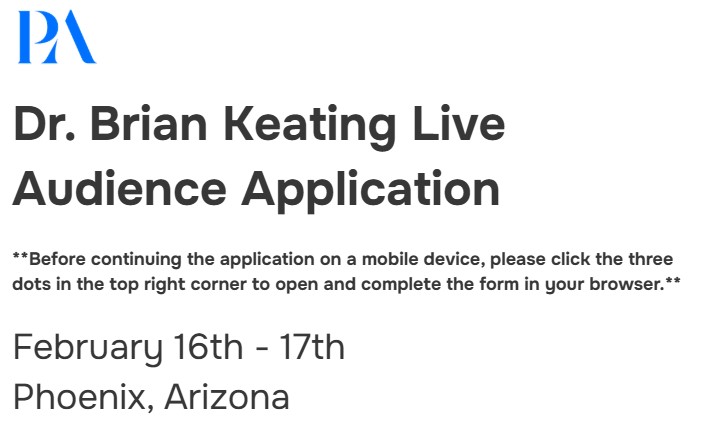
Join me for a free course on black holes in two weeks in Phoenix, AZ!
Submit your application link: https://keating.paperform.co/
You’ll be part of a live audience for your course recording. You’ll also receive 1-year access to the Peterson Academy platform.
If you can’t make it, you can take both of my PA courses — Intro to Astronomy and Intro to Cosmology, which are now available!
Join me on a 9-hour captivating journey through the cosmos, exploring its vastness, the tools used to unravel its mysteries and the groundbreaking discoveries that have shaped our understanding of the universe. We examine the evidence for an expanding universe, the forces driving its evolution, and the cosmic fossils that shed light on its distant past and future.
The course also delves into the enigmatic concepts of dark matter and dark energy, their roles in the universe’s structure and fate, and the ongoing efforts to unravel these cosmic mysteries.
Enroll now for immediate access at https://petersonacademy.com/?utm_source=Keating
Advertisement

By popular demand, and for my mental health 😳, I am starting a paid “Office Hours” where you all can connect with me for the low price of $19.99 per hour. I get a lot of requests for coffee, to meet with folks one on one, to read people’s Theories of Everything etc. Due to extreme work overload, I’m only able to engage directly with supporters who show an ongoing commitment to dialogue—which is why I host a monthly Zoom session exclusively for patrons in the $19.99/month tier.
It’s also available for paid Members of my Youtube channel at the Cosmic Office Hours level (also $19.99/month). Join here and see you in my office hours!
Upcoming Episode
David Sussillo — neuroscientist, AI researcher, and author of Emergence: A Memoir of Boyhood, Computation, and the Mysteries of Mind (out March 17).
Born to drug-addicted parents, David navigated violence, group homes, and neglect—yet a seed was planted at the unlikeliest place: a local arcade. Now he’s at the cutting edge of neuroscience.
What would you ask him?
Submit your questions here!