Why are so many scientists in the Epstein Files (including me)
Dear Magicians,
Before anything else: the Epstein files are, first and foremost, a record of victims. Children who were trafficked, exploited, and failed by every institution that should have protected them. We need accountability, and fast, if society is ever to recover from this.
- Orange jumpsuits, handcuffs, extensive prison time
- Guilty pleas; no back room deals
- Large monetary settlements
Now, what follows is about the scientists — but the scientists are not the story. The victims are. And they deserve more than a passing mention in a newsletter about academic complicity.
With that said.
I’ve spent most of my life arguing that science and rationality are our best hedge against self-deception. That the examined life is the only one worth living. I’ve never conflated knowledge with wisdom — A Brief History of Time by Stephen Hawking (a 2006 visitor to Epstein Island along with dozens of other scientists) is no more a guide to moral living than the Bible is a textbook on precision cosmology.
And then three million pages land on the internet and you watch some of the smartest people alive demonstrate, with exquisite clarity, that intelligence is no vaccine against stupidity.
The DOJ’s January 2026 Epstein file dump confirmed what many suspected but hoped wasn’t quite this bad. Nature reported that Epstein kept a curated list of nearly 30 top scientists. Not acquaintances. Not people he’d met at a cocktail party. Scientists he cultivated. Maintained. Deployed.
These were not backwater institutions thirsty for money — although Arizona State, a public university, topped the list in dealings with Epstein. These were places like Harvard, where multiple luminaries, including several past podcast guests and former president Larry Summers, turned out to be repeat presences in the files.
And then there’s me.
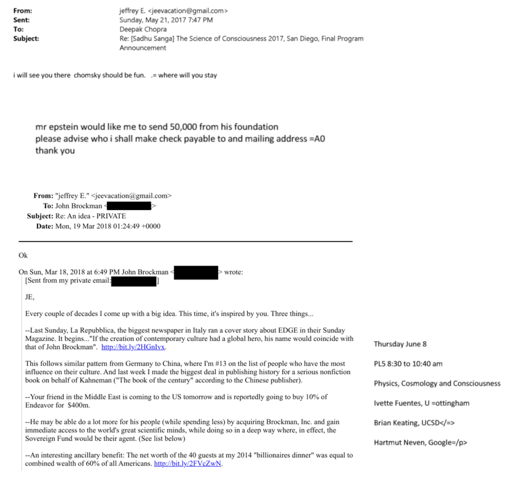
I didn’t Google myself this time. I Epstein-filed myself. To my horror, my name appears in at least 13 documents, including multiple emails sent to Epstein.
Two sources: I spoke at a 2017 consciousness conference in San Diego alongside Epstein’s favorite intellectual, Noam Chomsky, so my name was listed among the speakers. And my book agent, John Brockman, had one of the most extensive intellectual relationships documented in the files. Because I wrote for Brockman’s website, Edge.org, I found myself featured there too.
These appearances are relatively mild. But the shock gave way to disgust. Was there anything I could have done to prevent even the pixels of my name from crossing his inbox? I don’t know. What I do know is that whatever discomfort I feel is nothing — nothing — compared to what his victims endured.
According to Nature, the universities now implicated span at least a dozen of the most prestigious institutions on Earth: Harvard, MIT, Stanford, Yale, Duke, Princeton, Arizona State, NYU, Columbia, the Santa Fe Institute, the Institute for Advanced Study. Harvard alone received roughly $9 million and is launching its second investigation. Because the first one apparently didn’t investigate hard enough. Shocking — that an institution investigating itself might lack a certain enthusiasm for the task.
So why did so many brilliant people fall for this? I think about this a lot. Partly because “brilliant people being idiots” is a subject I have personal expertise in.
Three forces converged.
First, chronic underfunding. Academic science runs on scarcity. This is not a metaphor. Researchers spend a staggering percentage of their careers begging for money. Writing grants. Getting rejected. Writing more grants. And then a billionaire materializes offering millions with no bureaucratic overhead, no six-month review cycle, no forms in triplicate. The rational response is suspicion. The human response is relief. When you’ve been drowning, you don’t interrogate the guy throwing you a rope.
Second, status capture. Epstein didn’t just write checks. He hosted salons with Nobel laureates. He brokered introductions to powerful people. He created an ecosystem of intellectual flattery so intoxicating that serious minds confused proximity to wealth with evidence of their own importance. Scientists — people professionally trained to distinguish signal from noise — mistook “a predator finds you useful” for “you have arrived.”
Third, institutional moral outsourcing. If MIT and Harvard accepted his money, it must be fine. If Harvard hosted him in his own office on campus, someone must have vetted him. If a department chair is having dinner with the man, surely the ethical due diligence was done.
It wasn’t.
Nobody did it. Everyone assumed someone else had. The same psychological mechanism that explains why people don’t call 911 when there are thirty bystanders. Diffusion of responsibility. Except instead of failing to call for help, they were accepting checks from a convicted sex offender.
Now. I find the impulse to moralize from the cheap seats genuinely distasteful. It’s very easy to look at this wreckage and say, “Well, I would never.” Maybe you wouldn’t. But you probably haven’t spent a decade scrambling for funding while your lab’s future hinges on a government panel that meets twice a year.
The point isn’t that all these scientists were evil. Some may have been. Most were ordinary — ordinary in exactly the way that allows moral catastrophe to unfold. Not through malice. Through convenience. Through the slow erosion of standards when everyone around you is making the same compromise.
The fix isn’t complicated. It’s uncomfortable. Which is why it hasn’t happened.
Mandatory donor transparency. Independent ethics review of private philanthropy above a meaningful dollar threshold. And most critically: formal ethics education for scientists. My colleagues in the medical school, law school, and even the MBA program have mandatory ethics courses at every level. Scientists? At my university, we have nothing. We have biannual online training with anodyne examples about fudging lab data and video courses about avoiding conflicts of interest and sexual harassment — all of which merely require a 2h attention span and a working mouse… That’s it.
How is ethical judgment supposed to develop? By osmosis? We need to mandate these courses — and we need to get over the arrogance that tells us we don’t need them.
Your need for money is the handle by which you can be grabbed. Know the handle exists.
Brilliance without ethical vigilance is just useful naïveté. And useful geniuses, it turns out, were exactly the product Jeffrey Epstein was shopping for.
Until next time, have a M.A.G.I.C. Week,
Brian
Appearance
I talk to host of The Joy of X, Steven Strogatz, about chasing the universe’s greatest mysteries — and what it’s like to have a major discovery slip through his fingers.
Genius
First-of-its-kind Cleanroom Turns Inventions into Devices Ready for FDA Approval from my brilliant colleagues at UCSD
Image

Some images of the site taken from the drone and the TAO site in December 2025.
Credits: the POLOCALC/HoverCal drone team.
Conversation
In this episode, I sit down with neuroscientist and author Nikolay Kukushkin for a mind-expanding journey into the nature of consciousness, intelligence, and the surprising places they might reside—even inside a humble kidney cell.
Advertisement
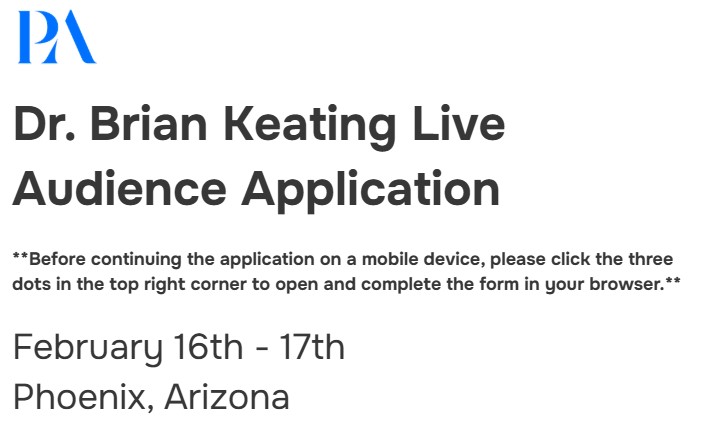
Join me for a free course on black holes in two weeks in Phoenix, AZ!
Submit your application link: https://keating.paperform.co/
You’ll be part of a live audience for your course recording. You’ll also receive 1-year access to the Peterson Academy platform.
If you can’t make it, you can take both of my PA courses — Intro to Astronomy and Intro to Cosmology, which are now available!
Join me on a 9-hour captivating journey through the cosmos, exploring its vastness, the tools used to unravel its mysteries and the groundbreaking discoveries that have shaped our understanding of the universe. We examine the evidence for an expanding universe, the forces driving its evolution, and the cosmic fossils that shed light on its distant past and future.
The course also delves into the enigmatic concepts of dark matter and dark energy, their roles in the universe’s structure and fate, and the ongoing efforts to unravel these cosmic mysteries.
Enroll now for immediate access at https://petersonacademy.com/?utm_source=Keating
Advertisement

By popular demand, and for my mental health 😳, I am starting a paid “Office Hours” where you all can connect with me for the low price of $19.99 per hour. I get a lot of requests for coffee, to meet with folks one on one, to read people’s Theories of Everything etc. Due to extreme work overload, I’m only able to engage directly with supporters who show an ongoing commitment to dialogue—which is why I host a monthly Zoom session exclusively for patrons in the $19.99/month tier.
It’s also available for paid Members of my Youtube channel at the Cosmic Office Hours level (also $19.99/month). Join here and see you in my office hours!