Peter Higgs Wouldn't Get Hired Today. Neither Would I.
Dear Magicians,
In a 2013 interview with The Guardian, he observed that he “wouldn’t be productive enough for today’s academic system” — and would likely have been fired before his most important work appeared. He said this without bitterness. It was just a fact about the environment he was describing.
He was right, and it’s worth sitting with how right he was.
In 1964, Higgs published the paper predicting the boson that would eventually carry his name. That paper was 2 pages. It followed a 3-page paper in the same year. Between 1966 and 1972, he published essentially nothing. By the metrics that govern modern physics departments — annual output, grant renewal, h-index trajectory — his career would have been flagged, reviewed, and quietly terminated somewhere around 1968.
The Higgs boson wasn’t confirmed until 2012. The Nobel Prize arrived in 2013. The mechanism he described in those two pages reshaped our understanding of why anything has mass. The entire Standard Model leans on it.
None of that would have happened inside a modern research university’s performance review cycle.
I’m not Peter Higgs. But I know what it is to pursue an idea for years without publishable output — the BICEP instrument had problems that took a decade to diagnose properly. I’ve watched colleagues with deeper physical intuition than mine leave the field not because the field rejected their ideas, but because the funding cycle rejected their silence.
The machine isn’t selecting for the best physics. It’s selecting for the most legible physics — work that can be explained to a committee in a grant renewal, broken into annual milestones, and defended at every step.
Higgs was doing something more fundamental. He was thinking.
The lesson isn’t nostalgia. The lesson is that whatever produced Peter Higgs — whatever institutional conditions allowed a person to think slowly and deeply for years without output — has been optimized away. We replaced it with productivity metrics because productivity metrics are measurable.
The Higgs field is everywhere, permeating all of space, giving mass to everything that has it. The conditions that produced Peter Higgs were not everywhere. They were specific, fragile, and we destroyed them because they didn’t look like progress.
Until next time, have a M.A.G.I.C. Week,
Brian
P.S. I share other life lessons from generous Nobel Prize winners in my newest book, Focus Like a Nobel Prize Winner. Please pick up a copy and if you already did, Thank you (and please leave a review)
P.P.S.: The system that produced Peter Higgs no longer exists. What would you say we should do to get it back? Does academia itself needs to change? That’s the subject of my conversation with Aswath Damodaran.
You can watch it here if you’re a member of my YouTube channel, or if you’re not, you can wait till tomorrow when it’s available to the public.
| Read Past Musings on BrianKeating.com → |
Appearance
My friend Jake Newfield put together something worth sharing — a long-form conversation on my quest for the origin of the universe, covering the Simons Observatory, the CMB, and what it actually feels like to chase a signal that may or may not exist. Along the way, we touch upon the perils and promises of AI in science. Watch it here.
| Watch the Full Episode → |
Genius
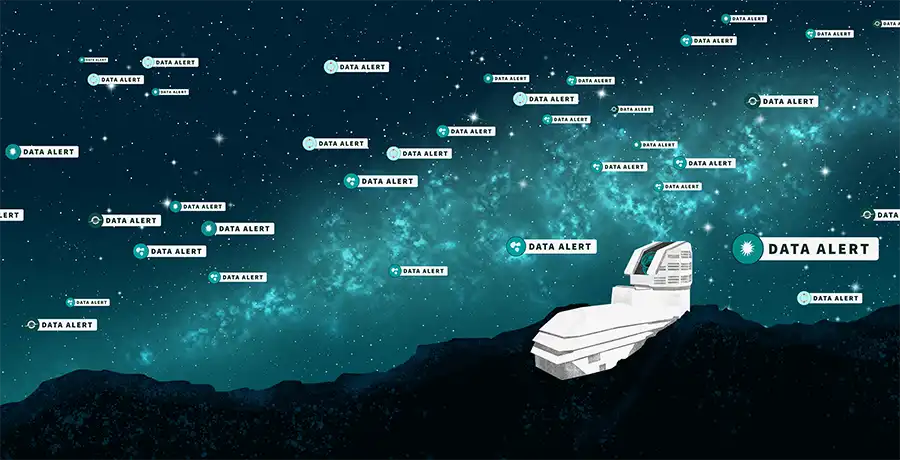
We built telescopes to see further. That was the story for 400 years. Rubin changes the story.
On February 24th, the Vera C. Rubin Observatory didn’t produce a breathtaking image. It produced 800,000 alerts — in a single night. Supernovae. Asteroids. Flickering black holes. All flagged, processed, and distributed to researchers worldwide in under two minutes. The system is eventually expected to reach seven million alerts per night.
The bottleneck in astronomy is no longer observation. It’s attention.
Which means the rarest resource in the universe isn’t photons — it’s the ability to focus on what matters among an incomprehensible flood of signal. Sound familiar?
That’s not just a cosmic problem. It’s your problem every morning.
| Read More at Sky & Telescope → |
Watch my viral interview with Mario Juric from last spring’s first light extravaganza!
Image
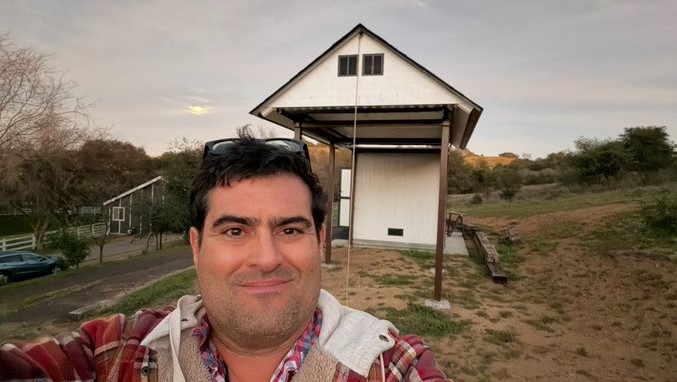
Preparing for last week’s lunar eclipse at The POLITE Observatory!
Conversation
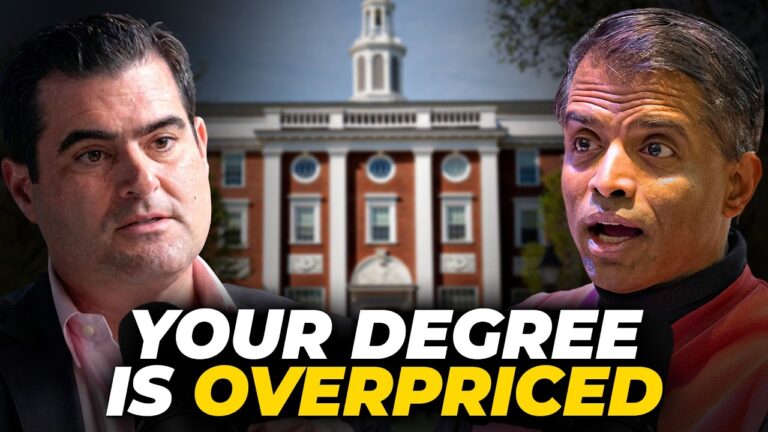
What’s The Real Value of Your Degree?
The system that produced Peter Higgs no longer exists. It was replaced, piece by piece, with something more accountable, more measurable, and less capable of producing Peter Higgs.
What would you trade to get it back? What would you have to give up? some say academia itself needs to change, and that was the subject of my conversation with Aswath Damodaran.
You can watch it here if you’re a member of my YouTube channel, or if you’re not, you can wait till tomorrow when it’s available to the public.
Members really help the channel get the attention from the dreaded AI algorithm that YouTube uses to promote videos over others. I could really use your help, and it’s only $1.49 /month.
| Watch on YouTube → |
Upcoming Episode
Upcoming Guest Vivienne Ming will be on The INTO THE IMPOSSIBLE Podcast soon.
Vivienne is a theoretical neuroscientist and AI researcher known for using machine learning to tackle deeply human problems—from predicting bipolar episodes to redesigning education and helping people recover lost cognitive abilities. What would you ask someone building AI to understand—and potentially improve—the human mind?
Submit your questions here: https://tally.so/r/mevW70
Advertisement

By popular demand, and for my mental health 😳, I am starting a paid “Office Hours” where you all can connect with me for the low price of $19.99 per hour. I get a lot of requests for coffee, to meet with folks one on one, to read people’s Theories of Everything etc. Due to extreme work overload, I’m only able to engage directly with supporters who show an ongoing commitment to dialogue—which is why I host a monthly Zoom session exclusively for patrons in the $19.99/month tier.
It’s also available for paid Members of my Youtube channel at the Cosmic Office Hours level (also $19.99/month). Join here and see you in my office hours!