I read 587 comments. One had a point. For that, I’m thankful.
Dear Magicians,
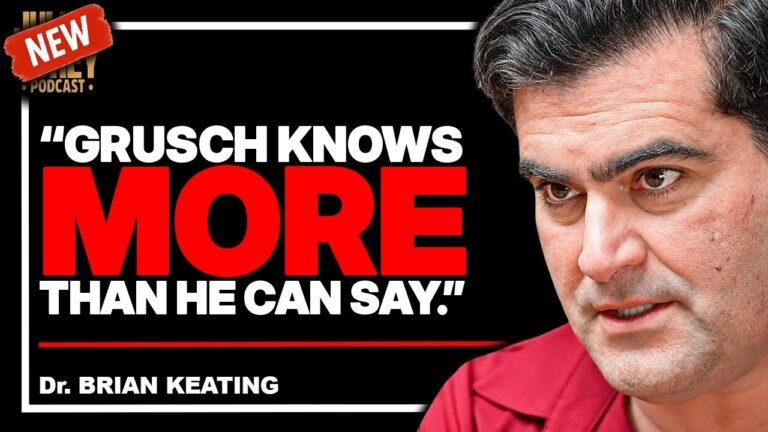
I went on Julian Dorey’s podcast to talk about aliens, God, and how we know what we know. By the time I got to the comments, I had apparently also been working for Mossad. This came as news to me, although it might explain why my travel reimbursement is taking so long.
Julian told me never to read the comments. I think that’s bad advice. It pays to know your audience. Also, I wanted to see if anybody thought I was funny, which is an embarrassing thing to admit at 55 and a considerably worse thing to investigate. In one batch of 99 comments, the critics outnumbered the enthusiasts about twelve to one. Julian’s position has some empirical support.
One commenter made an ugly insinuation about children. Another thought being Jewish explained my stupidity. Neither cost me much sleep. The one I kept thinking about came from somebody who said I’d talked for twenty minutes without saying much. I know what to do with the first two. The third fellow might have a stopwatch.
We had, in fairness, opened with a square in Flatland getting a visit from the third dimension. We got to wormholes, time travel, and the question of what evidence for alien life would actually look like. Somewhere along the way, though, I became interested in who gets to call himself “Professor.” One viewer finally wrote, “TEACH ME ABOUT SPACE.” I have some sympathy for a man who orders Saturn and gets a faculty meeting.
Somebody else asked whether he needed a PhD to be curious. That one bothered me. When I got my first telescope, my qualifications consisted of owning a telescope. Forty-five years later, I have a PhD, and Saturn looks pretty much the same. What I meant was that anybody can ask a question, and anybody who offers an answer owes the rest of us some evidence. If what came across was that you need my permission to ask, I’d like another crack at that sentence.
Would I go back a fourth time? I’m a little less eager after reading those comments. I’d be kidding myself if I said otherwise. But I like Julian. He let me finish my thoughts, including a few he could have ended early with the full support of his audience. If he calls with a question we’re both dying to answer, I suspect I’ll say yes. In the meantime, if the gentleman who wanted more space ever finds himself at one of my telescopes, I’d be happy to show him Saturn. I’ll even let him look before I explain anything.
Have a M.A.G.I.C. week.
Brian
Appearance
“There Must Be MORE Than Us!” Astrophysicist on Aliens, David Grusch & God
Julian Dorey makes long-form interviews for people who want the whole conversation, and he gave this one room to wander. We opened in Flatland, with the square that gets a visit from the third dimension, and used it to talk about holograms and how many dimensions our universe really has. From there we went to the multiverse, Kip Thorne and wormholes, reverse time travel, and why entropy gives time its arrow.
Then it got pointed. We got into scientists on podcasts, choosing guests, Bret Weinstein and Richard Dawkins, and what it means to call yourself “Professor.” We talked about why David Grusch matters, whistleblower protection, and the interstellar object 3I/ATLAS.
We closed on Einstein, the price of genius, humility and arrogance, and atheism versus agnosticism. One chapter title says it plainly: “Seek EVIDENCE for God!”
Genius
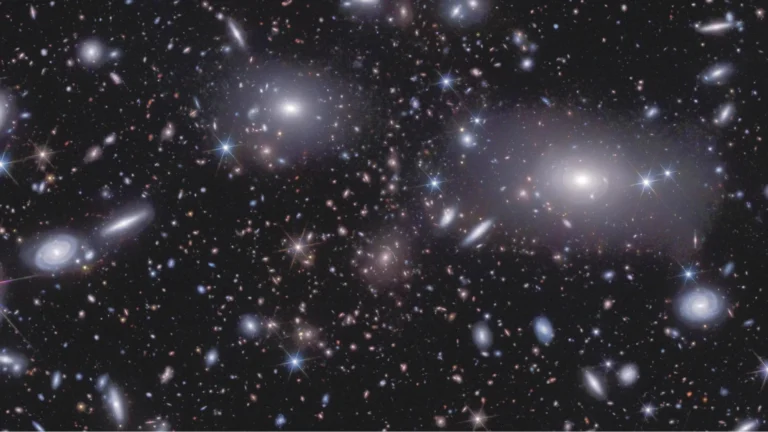
The Biggest Map of the Dark Universe Still Says “Not Yet”
On November 12 the European Space Agency opened the first big treasure chest from its Euclid space telescope: 1.7 petabytes of data, more than 900 million galaxies, spectra for more than 160 million sources, and around 15,000 candidate strong gravitational lenses. That is more lenses than every catalog before it combined.
Now read the fine print. Euclid’s first cosmology results are not expected until the full data release in mid-2027. The team is holding the largest map of the dark universe ever made, and it is still not telling you what dark energy is. Not yet. Not until the evidence is in.
When the release came out, I wrote on X that we can now map the universe in extraordinary detail, yet still cannot explain why its expansion is accelerating, or whether it still is. That is a confession, not a complaint.
Julian Dorey and I circled the same idea in our nearly three-hour conversation, out this week. Somewhere between Flatland and wormholes, we spent a stretch on a phrase scientists hate saying out loud: I don’t know. Later we turned it around and asked a harder question: how wrong are you willing to admit you might be?
Those questions matter more every week. Fields Medalist Alessio Figalli told me AI can now do every basic PhD problem in hours or days. Answers are getting cheap. What is not cheap is a well-posed question, and the patience to leave it open until the data closes it.
So here is my ask for Thanksgiving week. Pick one thing you are sure of. Before the pie arrives, write down the single piece of evidence that would change your mind. If you cannot name one, that is not certainty. That is a belief wearing a lab coat.
Euclid will make its case in 2027. You can make yours this Thursday.
Image: ESA / Euclid / Euclid Consortium / NASA; image processing J.-C. Cuillandre, E. Bertin.
Image
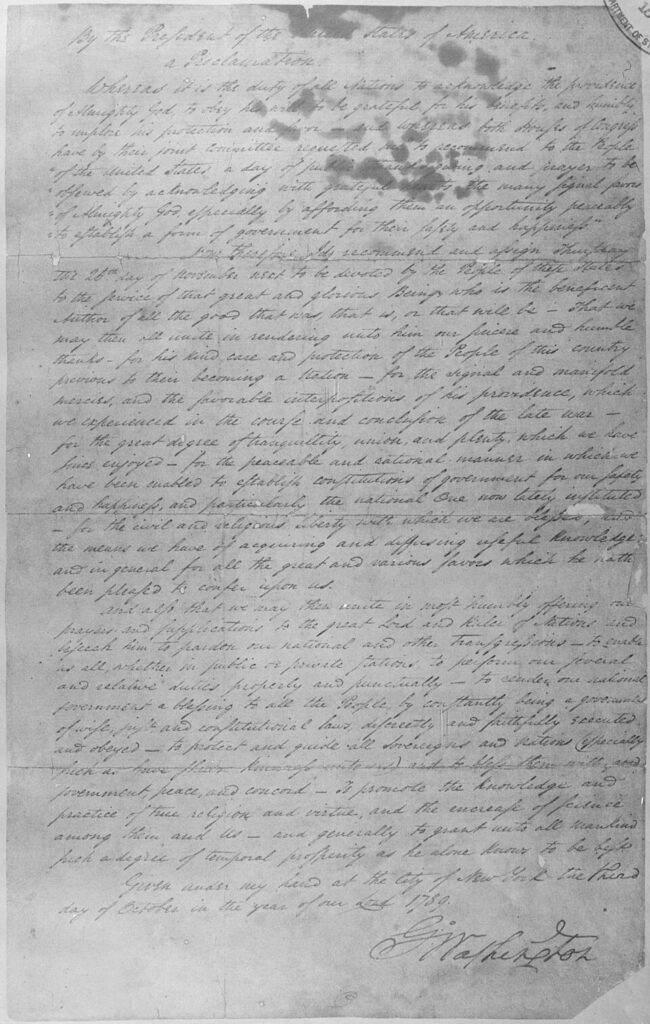
The First National Thanksgiving
On October 3, 1789, President George Washington signed this proclamation in New York, the nation’s first capital. It set aside “Thursday the 26th day of November” as a day of public thanksgiving. Read near the bottom and you will find a request for “the encrease of science among them and us.” Thanksgiving falls on November 26 again this year. Some things are worth keeping on the calendar.
Image: George Washington’s Thanksgiving Day Proclamation, October 3, 1789. U.S. National Archives. Public domain, via Wikimedia Commons.
Conversation
Latest on Into The Impossible
Physics Professor: His Math Says Even a 99.9% Efficient UFO Melts
Kevin Knuth is a physics professor at the University at Albany who takes UFO reports seriously enough to do the math on them. He came with slides and one question: how anomalous is anomalous?
Instead of arguing about little green men, he asks how much power a craft would need to do what pilots and sensors describe. For one Navy encounter, his numbers run past 1,000 gigawatts. Even at 99.9 percent efficiency, a craft drawing that much power would still shed about a gigawatt as waste heat.
I pushed back hard on whether every sensor was telling the truth or showing us an artifact. He was refreshingly candid, too: most sightings are probably not alien spacecraft, and one famous UFO photo in his slides turned out to be a seagull.
We did not agree on everything. That is why I liked it.
Advertisement
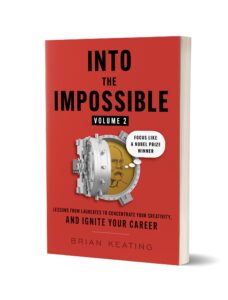
Tomorrow’s prize goes to a discovery made decades ago. Here’s how the winners made it: Focus Like a Nobel Prize Winner!
In Into the Impossible, Volume 2, I sat down with Nobel Prize winners to find out how they actually work: how they protect their attention, pick problems worth decades of their lives, and keep going when nobody else believes the result. Their answers are full of practical lessons you can use to concentrate your creativity and ignite your career, whether or not Stockholm ever calls.
Get your copy on Amazon and learn from the laureates themselves.