I was miscalibrated for 30 years
Dear Magicians,
I’m an experimental physicist who has spent three decades calibrating scientific instruments.
In 2012, I helped develop a technique called self-calibration for the polarization angles of Cosmic Microwave Background telescopes. It is still used today.
Recently, however, I discovered that the word calibrate may itself need calibration.
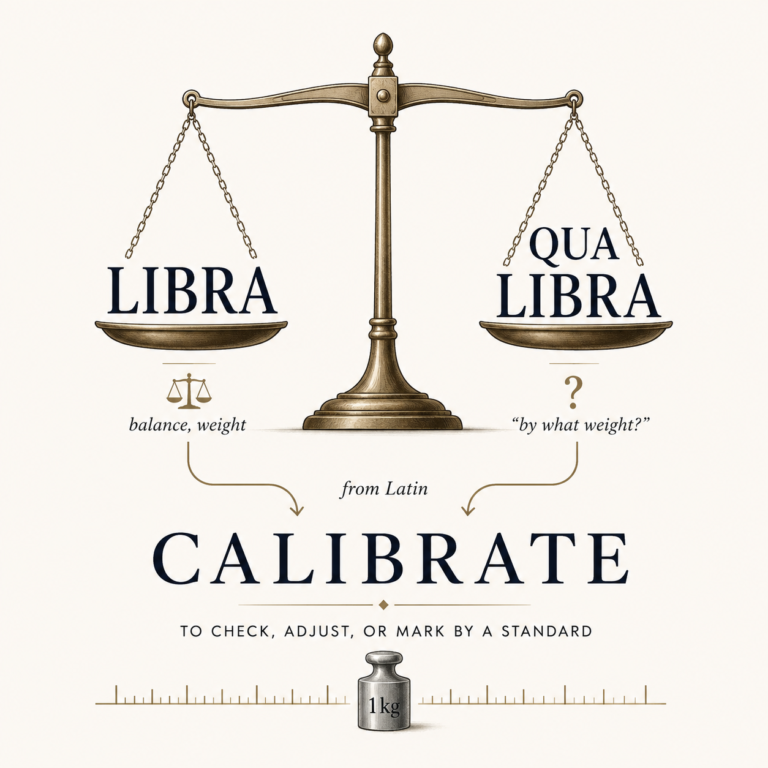
The word comes to English through French calibre, meaning the size or bore of something. After that, the etymological trail forks.
The conventional explanation traces calibre to the Arabic qālib, meaning a mold, form, or pattern, perhaps ultimately from a Greek word for a shoemaker’s last: the foot-shaped form around which a shoe was made.
That is wonderfully appropriate.
Long before SI units, human beings used their own bodies as standards. The foot. The hand. The cubit, or amah, derived from the forearm. Measurement began with an extraordinarily literal question: Compared with what?
But there is a rival etymology, probably wrong and almost too perfect to resist.
Some nineteenth-century scholars proposed that calibre came from the Medieval Latin quā librā: “by what weight?” Libra meant both a Roman pound and the balance used to weigh it.
Look again:
ca-LIBRA-te.
The derivation is disputed. The metaphor is not.
Calibration is fundamentally an act of comparison. You put the unknown on one side of the balance and a trusted standard on the other.
The Torah understood the stakes thousands of years before NIST. Deuteronomy forbids merchants from carrying heavy and light versions of the same weight and calls dishonest measures a to’evah, an abomination before God.
Today, instead of biblical weights, inspectors walk into supermarkets carrying certified masses. Put a known weight on the scale. Does the scale report the correct answer? If not, it can be taken out of service.
Modern technology changed enormously.
The epistemological problem did not.
And there is a subtlety even scientists routinely get wrong:
Calibration does not make an instrument correct. It tells you how wrong it is.
A thermometer can be calibrated and still read one degree too high. Calibration establishes the relationship between its answer and a trusted standard. Adjustment comes afterward.
Measurement asks:
What is the value?
Calibration asks the more dangerous question:
Why should I believe the value?
Which brings me back to self-calibration.
Ordinary calibration requires something external: a known mass, voltage, temperature, star, or other reference. Self-calibration tries to infer the reference from the data themselves.
That is extraordinarily powerful.
It is also dangerous.
Suppose theory predicts that some signal should equal zero. You can rotate your instrument until the signal disappears and declare yourself calibrated.
Unless the signal you erased was never an instrumental error.
Unless it was the new physics you were looking for.
After thirty years in experimental science, I find it reassuring—and slightly alarming—that even the word for checking our measurements against reality comes with its own error budget.
Until next time, have a M.A.G.I.C. week.
Brian
Appearance
This week I am teaching outside my own classroom.
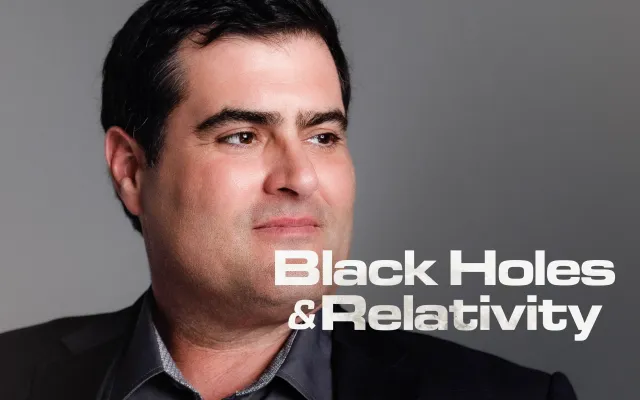
Black Holes & Relativity is live at Peterson Academy: eight hours on dark stars, Event Horizon Telescope images of the hole at the center of the Milky Way, gravitational waves, Hawking radiation, and the information paradox. We end on the physics of Interstellar, Gargantua, the Kerr metric, and what Kip Thorne actually signed off on.
If you want the lectures without the campus walls, that is the place.
Genius
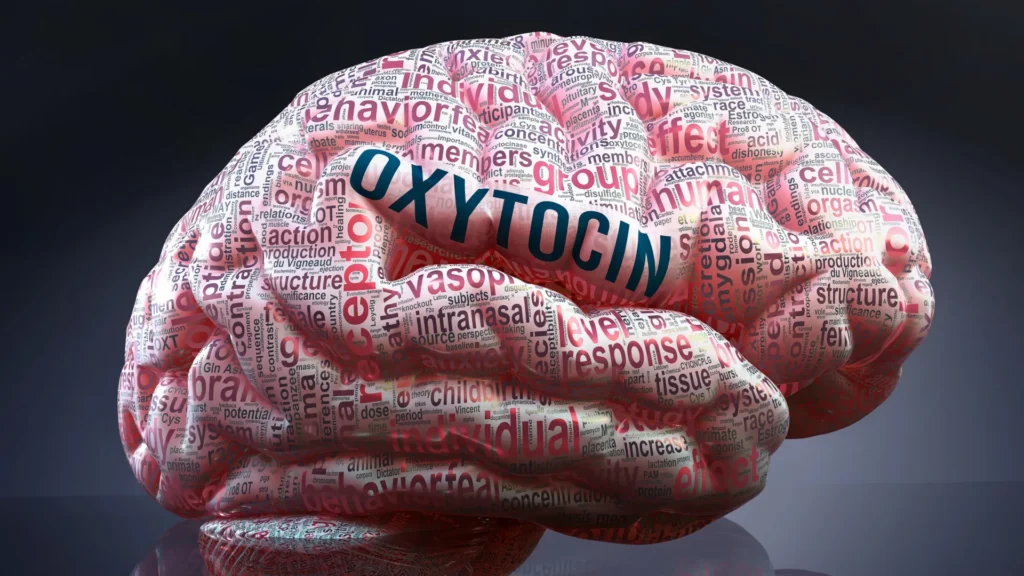
Oxytocin is the “love hormone.” Or so the press release said.
The actual literature, summarized in a 2014 Frontiers in Behavioral Neuroscience review, reveals something far more interesting: oxytocin doesn’t just increase in-group bonding and trust—it simultaneously increases out-group hostility, aggression, and conformity pressure. The hormone doesn’t make you loving. It makes you tribal. It amplifies “us” by amplifying the threat of “them.” Every study that found prosocial oxytocin effects was measuring in-group behavior.
Every intervention designed to increase social cohesion has this structural property: the stronger the we, the sharper the they. This isn’t a side effect of love—it’s the mechanism.
The communities you feel most warmly toward—who are they implicitly defined against? That’s the oxytocin at work.
Image
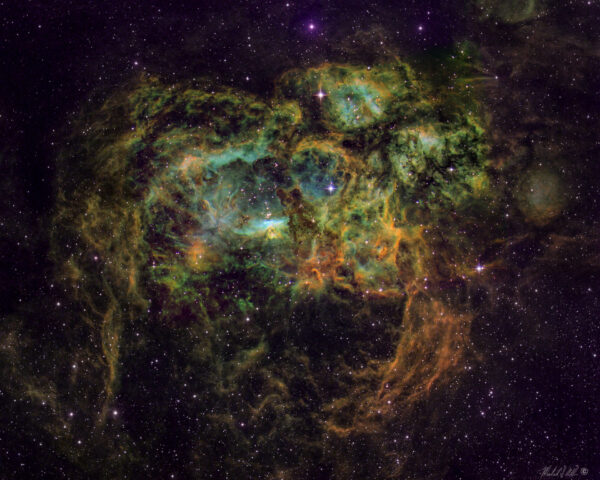
The Lobster Nebula, NGC 6357, about 8,000 light-years toward Scorpius. Massive stars in Pismis 24 light a 400-light-year tapestry of gas and dust. Hubble palette: green hydrogen, red sulfur, blue oxygen. 105 frames, 48 hours, Chile and Australia.
Conversation
Latest on Into The Impossible
This week’s Into the Impossible is with Nigel Goldenfeld, my UCSD colleague, on why neural nets work when the theory says they should not.
He treats generalization as a condensed-matter phase transition: the same physics that makes ice freeze can explain why a network interpolates instead of memorizing. The fridge-magnet version: AI works because it sits on the right side of a phase boundary, not because we discovered a new law of intelligence.
Audio is live on Apple Podcasts and at briankeating.com/podcast.
Advertisement

By popular demand, and for my mental health 😳, I am starting a paid “Office Hours” where you all can connect with me for the low price of $19.99 per hour. I get a lot of requests for coffee, to meet with folks one on one, to read people’s Theories of Everything etc. Due to extreme work overload, I’m only able to engage directly with supporters who show an ongoing commitment to dialogue—which is why I host a monthly Zoom session exclusively for patrons in the $19.99/month tier.
It’s also available for paid Members of my Youtube channel at the Cosmic Office Hours level (also $19.99/month). Join here and see you in my office hours!