Keith Olbermann said I should be fired for criticizing Scott Galloway. Scott said I am a credit to my employer.
Dear Magicians,
This weekend, I discovered that I am simultaneously a “bigoted imbecilic toad” and an “outstanding asset to the University of California.”
Apparently, it depends on whom you ask.
The first description came from Keith Olbermann. The second came from Scott Galloway, the man I’d actually criticized.
Here’s what happened.
I’ve admired Scott for years. He’s a bestselling author, podcast host, NYU professor, and newly appointed UC Regent. I’ve especially appreciated his outspoken defense of Jewish students and his willingness to debate people he disagrees with, including Ben Shapiro.
But his recent comments about Elon Musk troubled me.
Scott repeatedly called Musk a “traitor to the West” while invoking Julius and Ethel Rosenberg, who were executed in 1953 following their espionage-conspiracy conviction.
I thought that comparison was unwarranted.
To be clear, Scott never explicitly called for Musk’s execution. I said so in my original X post. But invoking executed spies while accusing someone of treachery invites a troubling historical inference that was an unnecessary incitement to violence. Scott should know better.
The internet responded predictably.
“The question here is: what are you going to do after they finally get rid of you from @uofcalifornia you bigoted imbecilic toad?”
A fascinating contribution to the marketplace of ideas.
Then something unexpected happened.
Scott Galloway asked me to call him.
We spoke at length about Musk, Ukraine, Starlink, Starshield, and academic freedom.
Scott emphasized that we need to establish exactly what happened with satellite communications in Ukraine. What was restricted? When? By whom? Under whose authority?
He even suggested Musk testify before Congress under oath.
Importantly, Scott acknowledged that if Musk was legitimately enforcing commercial contractual restrictions, accusing him of treachery would be unwarranted.
We still disagree about the Rosenberg analogy and I will expect a full apology from Scott if indeed I am proven correct.
And while I stand by my criticism, I recognize that my tone could have been more collegial.
But here’s where the story gets interesting.
Scott offered to publicly defend my academic freedom and my right to criticize him.
Think about that.
The man I criticized defended my right to criticize him, while a spectator anticipated my dismissal.
Scott subsequently posted on Threads, praising my work at UCSD and emphasizing our common ground.
We were both raised by single mothers. We’re Jewish, academics, fathers, and products of public education. We share a profound devotion to the University of California.
I invited him to Shabbat dinner.
He accepted.
As an experimental physicist, I teach students to distinguish evidence from inference and revise conclusions when confronted with new information.
It’s considerably harder when the experimental apparatus involves your own ego.
This weekend reminded me that defending an argument doesn’t require defending every word used to make it.
And that the person who challenges you may have more to teach you than the person who applauds you.
Monday Magic: Before writing someone off, consider calling them up.
You might discover a friend where you expected an adversary.
And perhaps most remarkably, two podcast hosts managed to disagree, talk it through, and find common ground without recording another podcast.
A first in unrecorded history.
Brian
Appearance
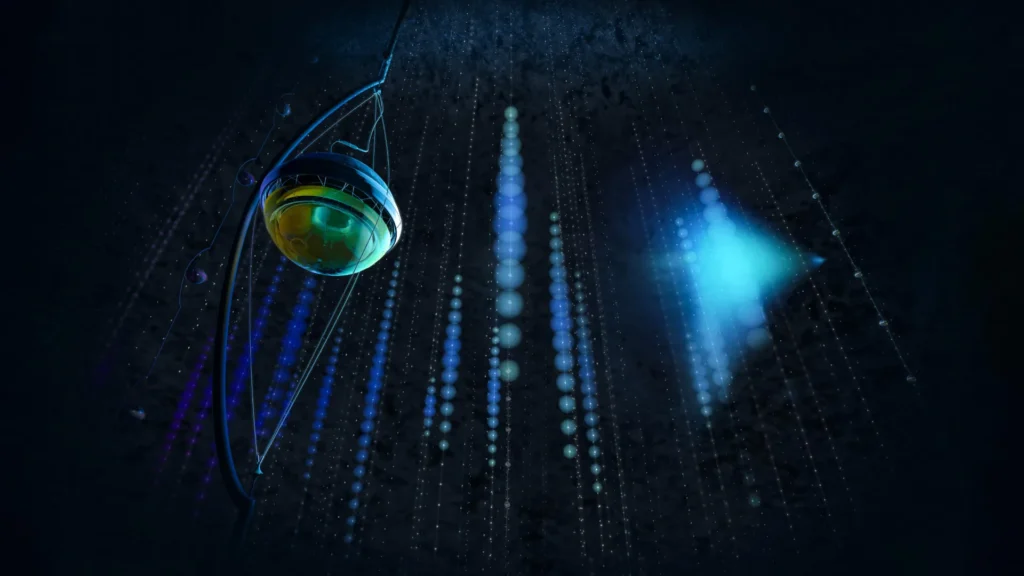
IceCube’s Ghost Particles, and a UC San Diego Window on the Early Universe
A new ScienceDaily feature from UC San Diego walks through the strange life of neutrinos, the nearly massless “ghost particles” that stream through Earth by the billions. Francis Halzen, who this year received a Nobel Prize for IceCube and the discovery of high-energy astrophysical neutrinos, built that Antarctic observatory into a cubic kilometer of clear ice. George Fuller, a Distinguished Professor of Physics at UC San Diego and an early IceCube collaborator, explains why some of those arrivals carry roughly 10 billion times the energy of a typical solar neutrino, and why their origins are still poorly understood.
The same piece turns to Chile’s Atacama Desert, where the Simons Observatory is gathering cosmic microwave background data that can also constrain neutrinos from the earliest moments after the Big Bang. UC San Diego helped establish the observatory, and I serve as its principal investigator. Fuller argues that Halzen’s vision opened a new window on the universe, and that Simons Observatory measurements could add another.
Genius
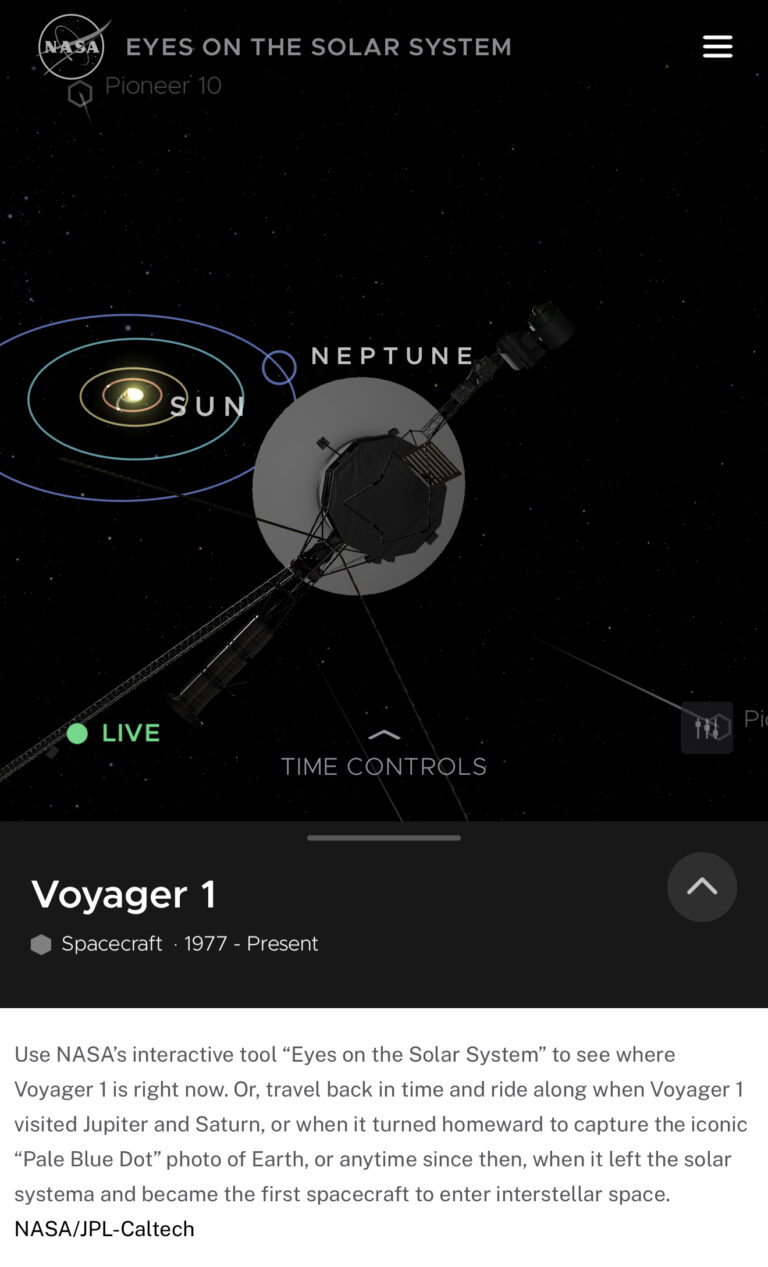
Voyager 1 went silent for 48 hours in October. Then its signal returned. NASA hadn’t sent a single repair command.
On November 18, it will be one light-day from Earth. Ask “Are you still there?” and wait TWO DAYS for an answer. At that distance, even panic travels at the speed of light.
Image
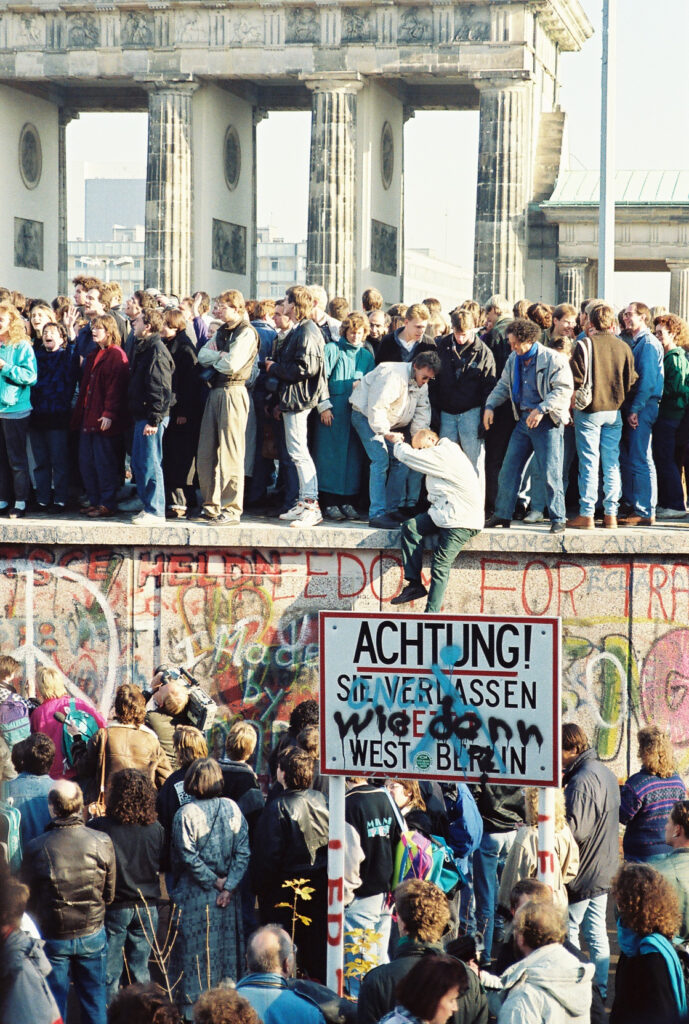
On Top of the Wall, November 9, 1989
Thirty-seven years ago today, East German spokesman Gunter Schabowski misread a travel memo at a routine press conference. Asked when the new exit rules took effect, he said, “Immediately.” Crowds rushed the checkpoints, and guards, waiting for orders that never came cleanly, opened the gates. By nightfall, Berliners stood atop the Wall near the Brandenburg Gate, under a sign warning “Achtung! Sie verlassen jetzt West-Berlin.” Someone had spray-painted a better question over it: “Wie denn?” How, exactly? That night, the answer was: by walking.
Read the National Archives anniversary note →
Image: Sue Ream, people atop the Berlin Wall near the Brandenburg Gate on November 9, 1989. Licensed under Creative Commons Attribution 3.0, via Wikimedia Commons.
Conversation
Latest on Into The Impossible
Princeton Mathematician: The AI Singularity Is Absurd
Sergiu Klainerman is the Eugene Higgins Professor of Mathematics at Princeton. With Demetrios Christodoulou, he proved that empty spacetime, Minkowski space, is nonlinearly stable under Einstein’s equations. That sounds technical. It is the difference between a solution that counts as physics and a solution that is only a ghost on paper.
In this conversation we talk about why slowly rotating black holes pass that stability test and why wormholes fail it. We talk about shocks that form no matter how small the nudge, about whether AI could reproduce a landmark proof, and about why Klainerman calls the AI singularity story absurd. He also has blunt advice for a 19-year-old who wants to do real mathematics, and a clear view of what universities still owe their students.
If you have been wondering which big claims in physics and AI survive a hard look, this is fifty minutes of a mathematician who has spent his career drawing that line.
Advertisement
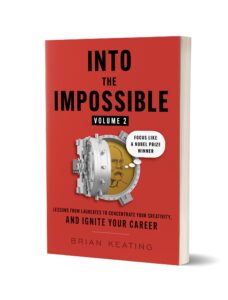
Tomorrow’s prize goes to a discovery made decades ago. Here’s how the winners made it: Focus Like a Nobel Prize Winner!
In Into the Impossible, Volume 2, I sat down with Nobel Prize winners to find out how they actually work: how they protect their attention, pick problems worth decades of their lives, and keep going when nobody else believes the result. Their answers are full of practical lessons you can use to concentrate your creativity and ignite your career, whether or not Stockholm ever calls.
Get your copy on Amazon and learn from the laureates themselves.