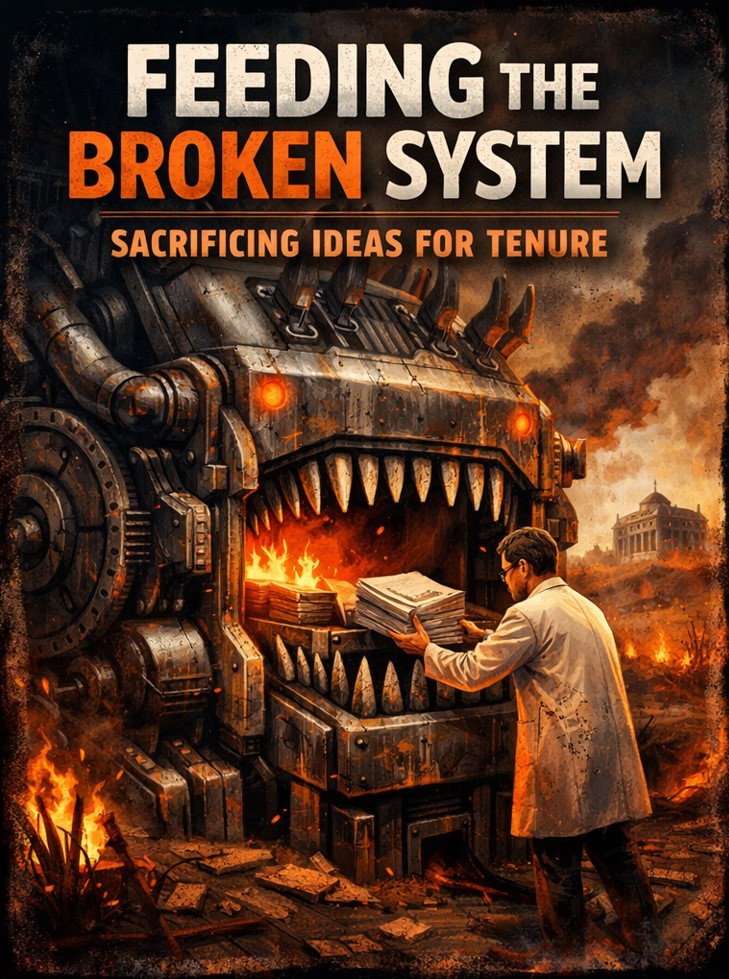
I fed the machine that was eating my field
Dear Magicians,
I spent a decade playing a game I knew was broken.
Not because I was naive. Because stopping meant losing. That’s the architecture of the trap — it doesn’t require ignorance from its participants. It requires rationality.
In my twenties I published papers I wasn’t sure were important. Not because they were intrinsically bad or safe; after all that may have required courage in the wrong direction. These were technically competent, methodologically sound, and aimed at the narrowest possible questions because narrow questions produce citable results. Citable results produce tenure. Tenure produces freedom. Freedom was the goal. The cost of freedom was a decade spent not using it.
The poet Allen Ginsberg called this dynamic Moloch — borrowing from the Canaanite god who demanded child sacrifice. The writer Scott Alexander formalized it: situations where every individual is choosing rationally and the collective outcome is catastrophic for everyone. Arms races. Outrage algorithms. Academic publishing. The game is visibly broken. Nobody stops playing because unilateral disarmament means professional death.
Here’s what nobody tells you about Moloch games: the players aren’t the problem. The incentive structure is the problem. And incentive structures don’t reform themselves because the people with the power to change them are the ones the current structure selected for.
I watch postdocs slice their best ideas into minimum publishable units — the intellectual equivalent of selling a house for lumber. They know it degrades the work. Their advisors know. The committee reviewing their dossier knows. Everyone performs the ritual because the alternative is being the one who didn’t.
The Talmud has a phrase for this: lifnim mishurat hadin — going beyond the strict letter of the law. The rabbis understood that systems optimized purely for compliance produce compliant people, not good ones. The fix isn’t better rules. It’s cultivating the kind of person who occasionally refuses to play.
You can’t beat a Moloch game from inside it. You can only change the rules, or build something adjacent where different rules apply. That’s what this newsletter is, in its small way. A space outside the algorithm, the citation index, the outrage loop.
The game is broken. You already know this. The question is what you’re building instead.
Until next time, have a M.A.G.I.C. Week,
Brian
P.S. I share other life lessons from generous Nobel Prize winners in my newest book, Focus Like a Nobel Prize Winner. Please pick up a copy and if you already did, Thank you (and please leave a review)
Appearance
I was a guest lecturer on Peterson Academy. My nine-hour Intro to Cosmology course just launched, and Lecture 1 is live now.
Here’s what we covered: cosmology as the laws of physics applied to the universe as a whole — origin, fate, expansion, the cosmic fossils (CMB, galaxies, dark matter, dark energy) that let us reconstruct billions of years of history from a single sky. I trace the arc from Genesis and ancient Egyptian cyclic models through Aristotle, Newton, and Einstein, all the way to precision cosmology.
The deeper thread: cosmology is the one science where you can’t rerun the experiment, so error, humility, and the intersections with philosophy and theology aren’t optional — they’re built into the discipline.
Enroll now for immediate access to the full 9h course at https://petersonacademy.com/?utm_source=Keating
Genius
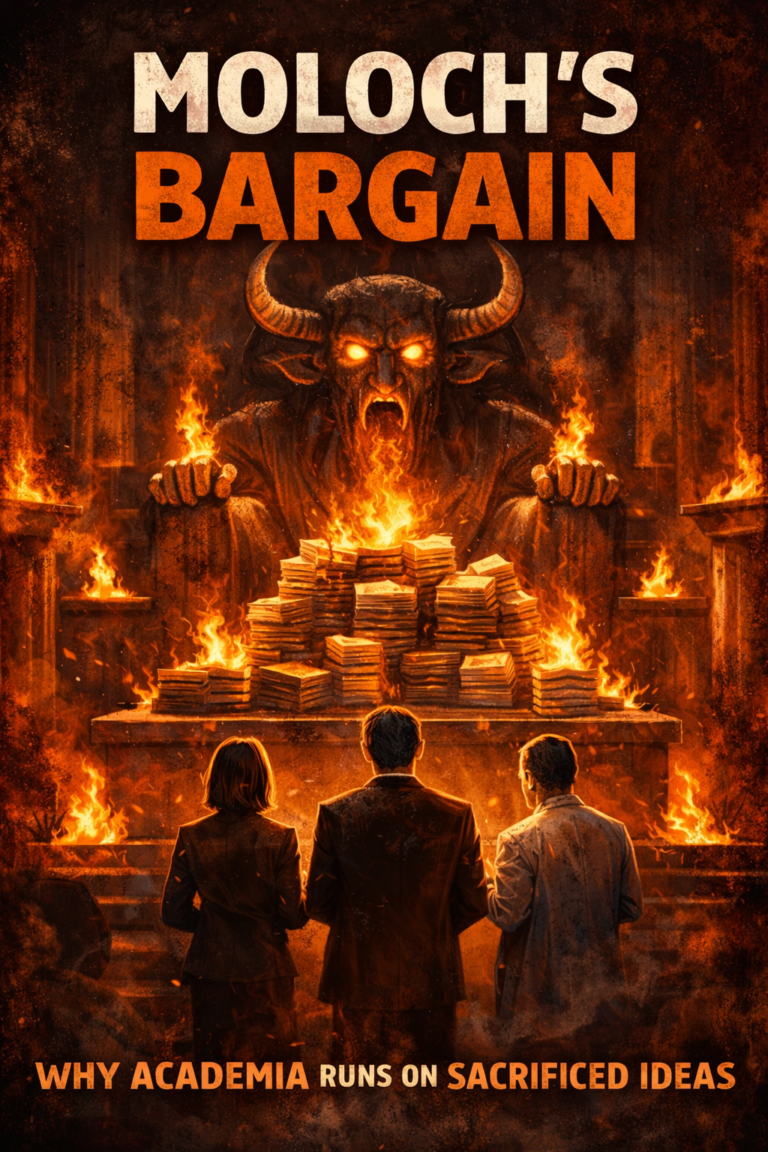
Moloch’s Bargain
Imagine a game where every player is choosing rationally—and the outcome is catastrophic for everyone.
Essayist Scott Alexander named this dynamic after the Canaanite god of child sacrifice: Moloch. It describes competitive situations where individual optimization leads to collective destruction. Nuclear arms races. Social media outrage loops. Academic publish-or-perish. Everyone knows the game is broken. Nobody stops playing—because stopping unilaterally means losing.
Most systems we call “dysfunctional” are actually functioning perfectly—just not for us. They’re optimizing for their own perpetuation, not human flourishing. That distinction matters enormously when you’re trying to fix them.
You can’t win a Moloch game by playing harder. You win by changing the rules, or refusing to play.
Which Moloch’s bargain have you quietly accepted as “just how things work”? The answer is uncomfortable.
Image

The superluminous supernova SN 2024afav / magnetar birth cry — a system that destroys what created it, producing something radically new — much like the Canaanite deity, Moloch.
Conversation
Latest on Into The Impossible
This week on Into the Impossible I sit down with neuroscientist David Sussillo — Meta Reality Labs researcher, Stanford professor, and author of Emergence.
David’s story is the living counterexample to everything I just wrote about Moloch: he grew up in group homes with drug-addicted parents and fought his way to the frontier of computational neuroscience and brain-machine interfaces. We talk about how intelligence emerges from chaos, why the brain is the ultimate system that nobody designed, and what recurrent neural networks actually teach us about consciousness.
If the Musing was about broken systems trapping rational people, this conversation is about what happens when someone refuses the trap entirely.
Channel members can watch it a day early — join here.
Advertisement

By popular demand, and for my mental health 😳, I am starting a paid “Office Hours” where you all can connect with me for the low price of $19.99 per hour. I get a lot of requests for coffee, to meet with folks one on one, to read people’s Theories of Everything etc. Due to extreme work overload, I’m only able to engage directly with supporters who show an ongoing commitment to dialogue—which is why I host a monthly Zoom session exclusively for patrons in the $19.99/month tier.
It’s also available for paid Members of my Youtube channel at the Cosmic Office Hours level (also $19.99/month). Join here and see you in my office hours!