The Question No Scientist Should Answer
Dear Magicians,
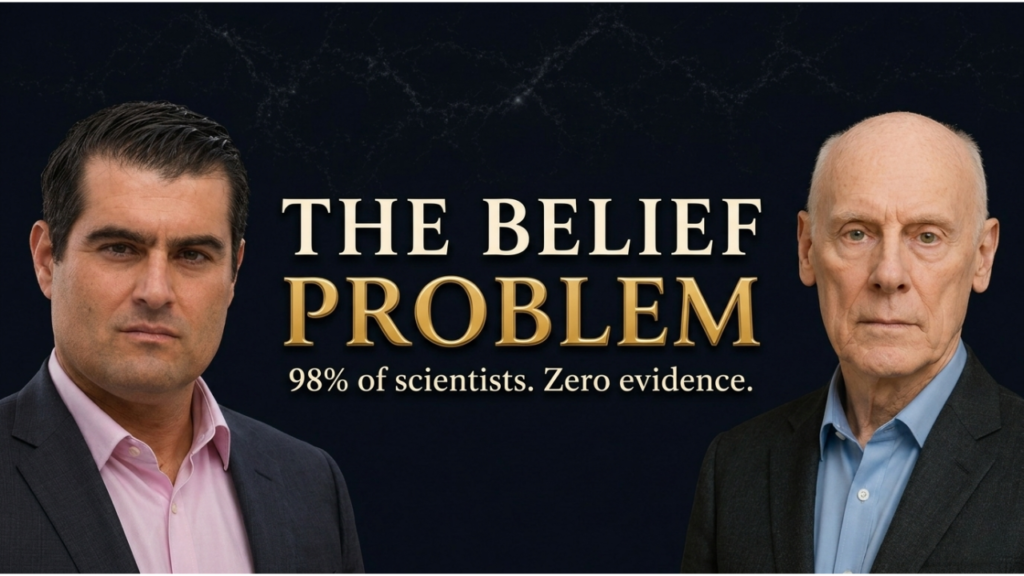
How a Nature survey turned a campfire question into a “finding” — and why every researcher who answered it should be quietly mortified.
There is a question no self-respecting scientist should consent to answer, and a thousand of them did it anyway — not over beers, not on a podcast, but in the pages of one of the most prestigious journals on Earth, with their names attached.
Do you believe in extraterrestrial life?
Per the Vickers et al. Nature Astronomy 2024 survey, 86.6% of astrobiologists said basic life is likely out there. The non-astrobiologists — who study other things for a living — agreed at 88.4%, which makes them slightly more confident about aliens than the actual alien experts, and should already be tripping a smoke detector somewhere. Strip out the fence-sitters and agreement rockets to 97.8%. The headlines wrote themselves and then high-fived: the experts have spoken, and the experts believe.
Let me be precise about what makes my skin crawl, because it is not the answer. It is the answering.
A scientist handed “do you believe in X?” has exactly one dignified move, and it is to refuse the grammar of the question. Belief is not the operator. Give me a proposition, a prior, and a body of evidence, and I’ll hand you back a credence with error bars and a faintly anxious expression. But “do you believe” is a question for a first date, not a discipline. To answer it — and worse, to answer it with a percentage, in Nature — is to let belief-polling cosplay as a method. That is the phrase that should make you blush. Not the yes. The RSVP.
Here is the test that proves they know better. I call it the astrology tell.
The astrology tell
Ask those same thousand scientists whether they believe in astrology and watch the body language change. Nearly all of them refuse — and, crucially, they refuse correctly. They don’t say “I believe astrology is false.” They say “astrology was tested, and it ate dirt.” When Shawn Carlson’s 1985 Nature double-blind trial ran real astrologers through a controlled experiment, they performed at chance — the cosmic equivalent of a coin that has heard of Mercury. That “no” is not a belief. It is a lab report wearing the modest cardigan of data.
Now set that beside the alien answer, and the asymmetry should make you wince — because it runs the opposite way from how the survey wants you to read it.
Astrology, for all its profound stupidity, at least had the nerve to stick its neck out. It made specific, present-tense, repeatedly testable claims — Mars in the seventh house means watch your wallet on Thursday — and those claims were put at risk and died in public.
I posted this on X and got an earful of hurt feels in the replies proposing either a) that the large numbers hypothesis is evidence (it’s not, it’s just an astrobiological version of the gambler’s fallacy.)
Or b) “belief is totally fine for a scientist”
Ok. So let’s ask those same thousand scientists whether they believe in astrology and watch their body language change.
Nearly all of them refuse, crucially, they refuse correctly. They don’t say “I believe astrology is false.”
They say “astrology was tested, and it ate dirt.” When Shawn Carlson’s 1985 Nature double-blind trial ran real astrologers through a controlled experiment, they performed as well as the cosmic equivalent of a Mercury Dime flip. Do you really want to go there?
The proposition “life exists somewhere among 10²⁴ stars” makes no checkable prediction whatsoever. You can never survey the complement. You cannot falsify it even in principle, never mind before lunch. It is not that the claim is unproven; it is that the claim has no truth conditions a working scientist could ever lay a glove on.
So here is the line I want carved into something permanent:
Notice the astrology row is the only one where “belief” is even a coherent thing to hold a position on — and it is the one they’d all decline to answer. That refusal is the whole proof. They know precisely how to behave when a question threatens their hopes. They simply forgot how the instant a question started flattering them instead.
The next time someone asks what you believe, try replacing belief with probability. Watch how much more precise the conversation becomes.
Until next time, have a M.A.G.I.C. Week,
Brian
P.S. I’m talking to Avi Loeb today at 11a – if he proves aliens are discovered, I reserve the right to become unbearably bitter.
Appearance
Last week, Mayim Bialik asked me a question that I think every scientist secretly fears:
“What if you’re wrong?”
Watch the conversation here.
If you watched it, leave a comment – I read every one of them. And I’m a co-creator of this video too 😀
Genius

🔬⚛️ In just 59 days, a new neutrino experiment surpassed the precision of every previous neutrino experiment combined. 🤯One of the biggest mysteries in physics is that neutrinos have mass, but we still don’t know exactly how their masses are arranged.
This week, the massive JUNO detector in China reported its first major result: after just 59 days of data, it measured key neutrino oscillation parameters with 1.6× better precision than all previous experiments combined. That’s an astonishing leap from less than two months of observations.
Neutrinos rarely interact with matter, yet they may hold clues to why the Universe looks the way it does. Sometimes the most important discoveries come from the particles that are hardest to catch.
Image
Conversation
Latest on Into The Impossible
Latest on Into The Impossible
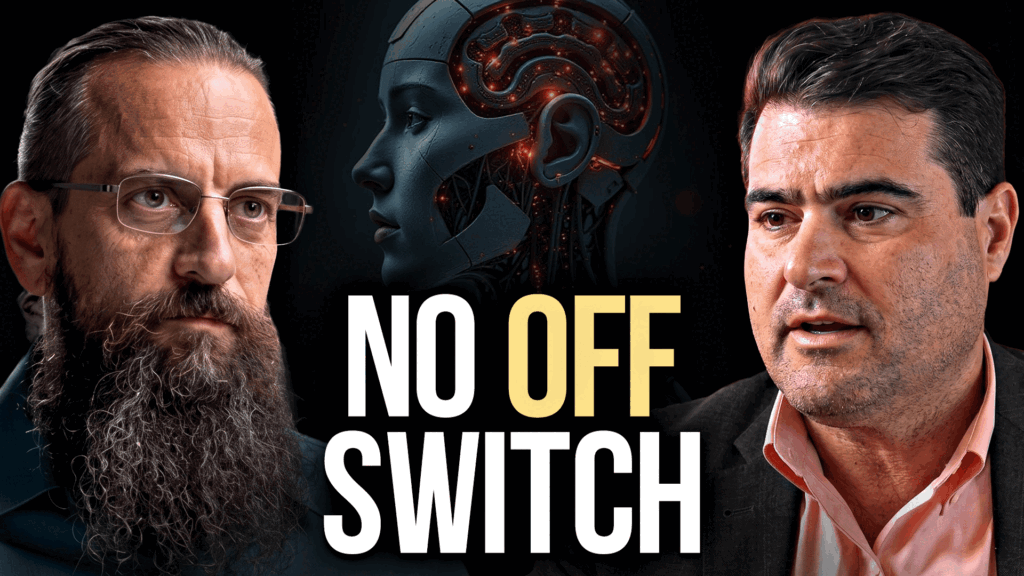
What if the smartest thing humanity ever creates is also the last thing humanity ever creates?
This week I sat down with AI safety researcher Roman Yampolskiy to discuss exactly that.
I found his answers terrifying. What about you?
Advertisement

By popular demand, and for my mental health 😳, I am starting a paid “Office Hours” where you all can connect with me for the low price of $19.99 per hour. I get a lot of requests for coffee, to meet with folks one on one, to read people’s Theories of Everything etc. Due to extreme work overload, I’m only able to engage directly with supporters who show an ongoing commitment to dialogue—which is why I host a monthly Zoom session exclusively for patrons in the $19.99/month tier.
It’s also available for paid Members of my Youtube channel at the Cosmic Office Hours level (also $19.99/month). Join here and see you in my office hours!
Advertisement

$14,000+ in AI tools. One card. $199
Unlock $14,000+ in AI tools, credits, templates, perks and partner benefits with the AI Executive’s Pass. Built for operators, founders and leaders who want to move faster with AI.