Physics Has a Faith Problem, Which Is Awkward Because So Do Physicists
Dear Magicians,
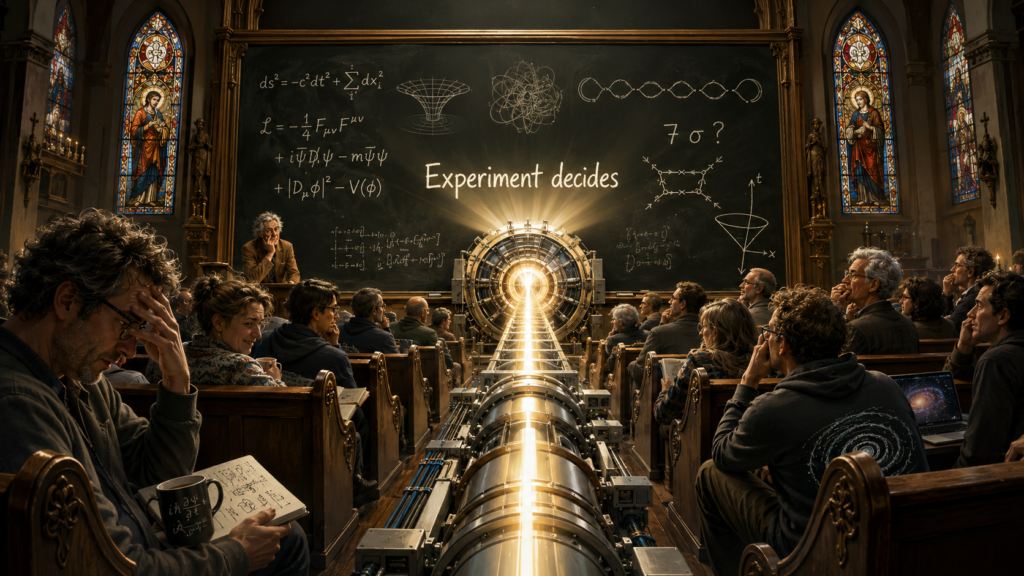
Every so often, science hands you a mirror and what you see is not always pretty. It turns out the people who pride themselves on being painfully rational are still people. We form tribes. We follow fashions. We tell ourselves stories. Some of us even do it while holding chalk or a telescope.
A recent survey by past guest Niayesh Afshordi and colleagues asked 1,675 physicists what they believe about the deepest questions in physics: gravity, black holes, the constants of nature, and whether the universe keeps perfect receipts like a jilted ex. At first, this looks like a survey of scientific opinion. Look closer, and it becomes something funnier and more awkward: a scan of what physicists believe when the data run out and personality enters the room.
Here is the result that should make everyone gently put down the espresso. The most popular candidate for quantum gravity was String Theory / M-Theory. Not a majority, just the top vote-getter, at 18.9 percent. So democracy has spoken, and democracy apparently wants extra dimensions, several of which are still hiding from law enforcement a.k.a. experimentalists like me.
The problem is simple: string theory has no independent experimental confirmation. After decades of brilliant work, it has not given us a clean prediction nature had to answer. No clear test. No number the universe could check. No awkward moment where the experiment says, “Absolutely not.” That does not mean string theory is dumb. It is almost certainly much smarter than I am, which is not the highest bar in modern physics. But it does mean something uncomfortable: the community that tells everyone else, correctly, that evidence matters most has given its biggest vote to the theory with the least evidence. And all we ever get is “trust me bro”. It feels like experimentalists are being Rickrolled constantly.
A normal person says, “Well, scientists are only human.” A physicist says the same thing, but first defines “human” using equations no one asked for. The survey also found that beliefs cluster. Physicists who favor string theory are much more likely to believe that black holes preserve information. The link is reported at 7 sigma, which is physicist-speak for “this is not a tiny coincidence.” But the discovery is not a particle. It is a pattern of belief. Beliefs travel in packs. The authors politely call this “coherence in respondent worldviews.” That is a very academic way of saying: intellectual denominations exist, even in physics, just like in religions.
To be fair, a worldview is not automatically bad. People’s views on religion, politics, medicine, education, and culture often move in clusters. We see teachers, heroes, peer pressure, identity, and the desire to belong. Physics is not immune to groupthink. It just writes the hymns in LaTeX.
The survey has another delightful landmine: 8.9 percent of physicists picked “an intelligent designer” as the explanation for why the constants of nature allow life. Nearly one in eleven. In a physics survey. Somewhere, Steven C. Meyer is smiling.
I do not say this to sneer. Sneering usually ages badly. The real lesson is better: scientists do not stop being human when they learn advanced math. We still care about beauty, status, teachers, friends, elegance, and being on the winning side of reality. We just learn better words for hiding those motives from ourselves. The good news is that the survey also shows science working. Support for ideas like supersymmetry and WIMPs has dropped because experiments tested them and found nothing. Testable beauty got bruised by data. Untestable beauty stayed elegant because nothing had been allowed to hit it.
The danger is not that physicists have intuitions. But Feynman’s rule holds firm: if experiment disagrees with you, you are wrong. It does not matter how beautiful the idea is. It does not matter how many famous people nodded near a blackboard. It does not matter how many extra dimensions the theory brought for emotional support. Without that rule, a physics department becomes a congregation with harder homework. The point is not that string theory is false. It is not that physicists are secretly religious. It is simpler and more annoying: even in physics, beliefs circulate in social circles.
Have a MAGIC week!
Brian
Appearance
Why haven’t we found aliens yet?
There are an estimated 10²⁴ planets out there — and still, total silence. Brian explains why: our farthest-traveled spacecraft, Voyager, has only gone one light-day from Earth in 55 years. Our own radio signals have barely reached 90 light-years into a galaxy that’s 100,000 light-years across. We’re not just alone-looking — we’re basically deaf and blind.
Have we already passed the “Great Filter” that wipes out civilizations before they’re ever found? Or are we being watched, and simply not worth the visit?
Genius
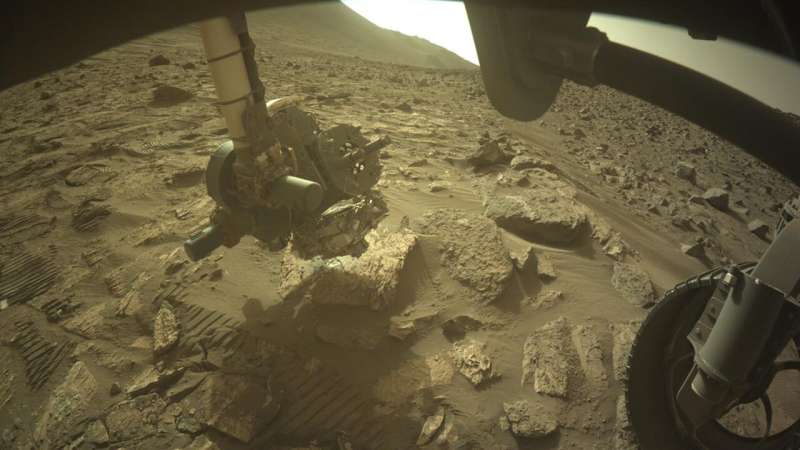
Mars keeps offering us evidence that looks biological enough to haunt the imagination, but not biological enough to satisfy a good experimentalist.
The recent discovery of complex organic carbon in ancient lakebed mudstones is exactly the sort of clue you would hope to find. Also exactly the sort of clue chemistry can forge without life. Nature has terrible respect for our categories.
Image

America @ 250
📸 credit: Me in Teton National Park last week!
Conversation
Latest on Into The Impossible
Photos from before satellites existed show something in orbit
Astrophysicist Beatriz Villarroel found flashes of light in old sky photographs — taken before Sputnik, before any satellite ever launched. On one 1950s photo, nine flashes appeared at the exact same instant. Nothing man-made could have caused them, because nothing was up there yet.
Her project VASCO scanned 600 million objects across 70 years of sky surveys. She ruled out asteroids, cosmic rays, and camera defects. What she found instead: a strange gap in Earth’s shadow, and flashes that spike around nuclear test dates.
She says the data speaks for itself — and that she now fears for her safety.
Advertisement

By popular demand, and for my mental health 😳, I am starting a paid “Office Hours” where you all can connect with me for the low price of $19.99 per hour. I get a lot of requests for coffee, to meet with folks one on one, to read people’s Theories of Everything etc. Due to extreme work overload, I’m only able to engage directly with supporters who show an ongoing commitment to dialogue—which is why I host a monthly Zoom session exclusively for patrons in the $19.99/month tier.
It’s also available for paid Members of my Youtube channel at the Cosmic Office Hours level (also $19.99/month). Join here and see you in my office hours!