Professor, lecture thyself!

An Open Letter to Adam Grant
Dear Adam,
One professor to another, and as an admirer: your recent New York Times essay on return-to-office mandates “The Secret Reason Bosses Want Everyone Back in the Office, Every Day of the Week” is witty and provocative. Yet it leaves unexplored what may be its most accessible and scientifically revealing test: studying the profession you and I share.
The NYT headline promises “the secret reason” bosses want everyone back and answers it in a single word: ego. It illustrates one of social psychology’s oldest cautions: the temptation to explain organizational decisions by personality before exhausting situational explanations. More specifically, narcissism. That’s a striking claim. It’s also perilously close to the fundamental attribution error: explaining behavior by personality while overlooking circumstance. A social psychologist should be the last person comfortable making that move.
The irony is that your own essay quietly builds the competing theory. You discuss anchor days, cite Atlassian’s finding that intensity matters more than frequency, distinguish basketball teams from gymnasts, acknowledge that remote patent examiners thrive while remote inventors struggle, and concede that mentoring, apprenticeship, creativity, and collaboration are not equally suited to remote work.
Maybe Jeff Bezos has a colossal ego. Maybe Elon Musk is an outright narcissist. I’ll grant you both, Grant. But Amazon also has warehouses. Tesla builds cars. SpaceX launches rockets. Hospital CEOs employ nurses. Airline bosses need employ gate agents and mechanics. It is difficult to assemble an F-150 over Slack. Ego and operational reality can both be true, and more than one may explain a return-to-office policy.
Because I’m a scholar, I did what scholars are supposed to do. I didn’t stop with the popular New York Times essay. I read the underlying paper. Not that you need to hear it from a physicist, but to your credit, the paper is extremely well-done. It’s noticeably more careful than the op-ed. It explicitly controls for frontline-dependent industries, a nuance readers of the NYT never see. But it also reveals something more troubling. The remarkable diversity of the Fortune 500 is ultimately reduced to a binary distinction: frontline-dependent or not. Boeing, hospitals, Amazon fulfillment, manufacturers, retailers, and airlines become one category. Microsoft, Oracle, Goldman Sachs, and consulting firms largely become the other.
That is a useful first approximation. It is not the same as demonstrating that the remaining variation is best explained by narcissism. Organizations differ in apprenticeship, occupational mix, innovation, security, and the simple feasibility of remote work. Those are precisely the kinds of situational variables brilliant social psychologists like you usually urge us not to ignore, and correctly so.
But one prof to another, the most interesting counterexample isn’t Amazon. It isn’t Tesla.
It’s us.
The professoriate is perhaps the most remote-capable prestige profession on Earth. We need no assembly line, no operating room, no warehouse. If any profession should have embraced permanent Zoom, it was ours.
The lecture hall should be among the richest sources of narcissistic supply. We stand in front of attentive audiences. We supervise apprentices. We direct laboratories. We enjoy unusual autonomy. If anyone should have preferred permanent in-person work because of admiration alone, surely it would have been professors, many of whom have lifetime sinecures no CEO enjoys: tenure!
And yet universities eventually came back — remember teaching 90 minute lectures wearing masks in front of the healthiest cohort on earth — vaccinated 18-22 year old undergrads (also wearing masks)!?
I’ll never forget it. We didn’t return to work because our fellow faculty suddenly developed a craving for applause we somehow lacked in 2019, but because something essential had been lost. Apprenticeship became denuded, bland, ineffective. Mentoring became harder. Conversation became less spontaneous. Research groups lost cohesion. Learning itself changed. That certainly matches my experience—and, I suspect, the experience of many faculty, students, and parents. If you don’t believe so, ask any student or parent who endured the 2020 Spring and Fall quarters at home supervising multiple Zoom instances in between their own sessions required by work!
Interestingly, your paper quietly suggests as much. Buried under the category “Learning” is perhaps its most important observation: “An apprenticeship model is almost impossible to replicate in the Zoom world.” That observation suggests a serious competing hypothesis.
It also points toward a much simpler explanation than narcissism: some forms of teaching, mentoring, creativity, and collaboration genuinely improve when human beings occupy the same room.
One aspect of the paper genuinely surprised me. The strongest experimental evidence supports power, not status, as the key mechanism linking experimentally induced narcissistic thinking to resistance to remote work. Not that power hunger is somehow angelic but it belies nearly every memorable line in the New York Times essay which suggest status as the driver: “the glow of employee reverence,” “the thrill of a live audience” and of course the journal article’s title: “Worship me at the office altar.”
Those are rhetorically brilliant phrases. They are also describing precisely the mechanism that the paper’s own causal experiment failed to establish: Study 3, your only randomized experiment, reached a far subtler conclusion than the op-ed. Experimentally increasing narcissistic thinking produced only a modest increase in resistance to remote work, and it did so primarily through power, not status.
Those exposed to the narcissism message were slightly more likely to favor return-to-office policies. The main reason wasn’t a desire for admiration—it was a stronger desire for power and control over employees. Again, not great personality traits, but your own experiment suggests that narcissistic thinking can modestly increase resistance to remote work, primarily by increasing leaders’ desire to exert authority rather than their egoic need for status or applause.
None of this proves ego-driven return-to-office mandates don’t exist. Some, maybe many, undoubtedly do. Your findings on power may well help explain them. But the deeper scientific question was never whether narcissistic CEOs exist. It is which work arrangements produce better products, stronger organizations, deeper learning, richer apprenticeship, and greater innovation.
That question deserves competing hypotheses. So, from one professor who could have outsourced himself to recorded lectures years ago, but chose the classroom for reasons that had nothing to do with being worshiped at the lectern:
Professor, lecture thyself!
The most interesting untested population may be us — professors: a profession unusually rich in status and autonomy, and unusually capable of working remotely. If narcissism is a major driver of return-to-office preferences, academia offers a natural test case. Your studies convincingly demonstrate that narcissism contributes to remote work resistance. As far as this experimental physicist could tell, they do not tell us whether it is the dominant explanation or merely one contributor among many operational realities.
So run the experiment on the profession you and I actually share. That would be fascinating, wouldn’t it? Sure, it might make you less popular around the Faculty Club. But academia offers a uniquely powerful test case: a profession unusually rich in status and autonomy, yet unusually capable of working remotely. If narcissism is a major driver of return-to-office preferences, then differences in narcissism among professors should predict differences in attitudes toward remote teaching. If apprenticeship, mentoring, and pedagogy dominate, disciplinary and educational differences should matter far more. Best of all, you and your colleagues already have access to exactly the population needed to answer the question. And if you’re looking for a narcissistic physicist to include in the sample, I happily volunteer. Good science begins with a willingness to test one’s own hypotheses—including those about oneself.
Respectfully,
Brian
Appearance
Time might not be real.
I joined Peter McCormack to dig into one of physics’ strangest open questions: what time actually is, and why it seems to only move forward. We get into what may have existed before the Big Bang, why something can’t come from nothing, and how my work with the Simons Observatory could catch gravitational waves from the universe’s first moments. Then the conversation turns from cosmic time to the human kind: mortality, family, attention, and whether AI could ever replicate the kind of insight that let Einstein rewrite physics.
Watch the full conversation to find out why I think we need to stop apologizing for humanity’s greatness.
Genius
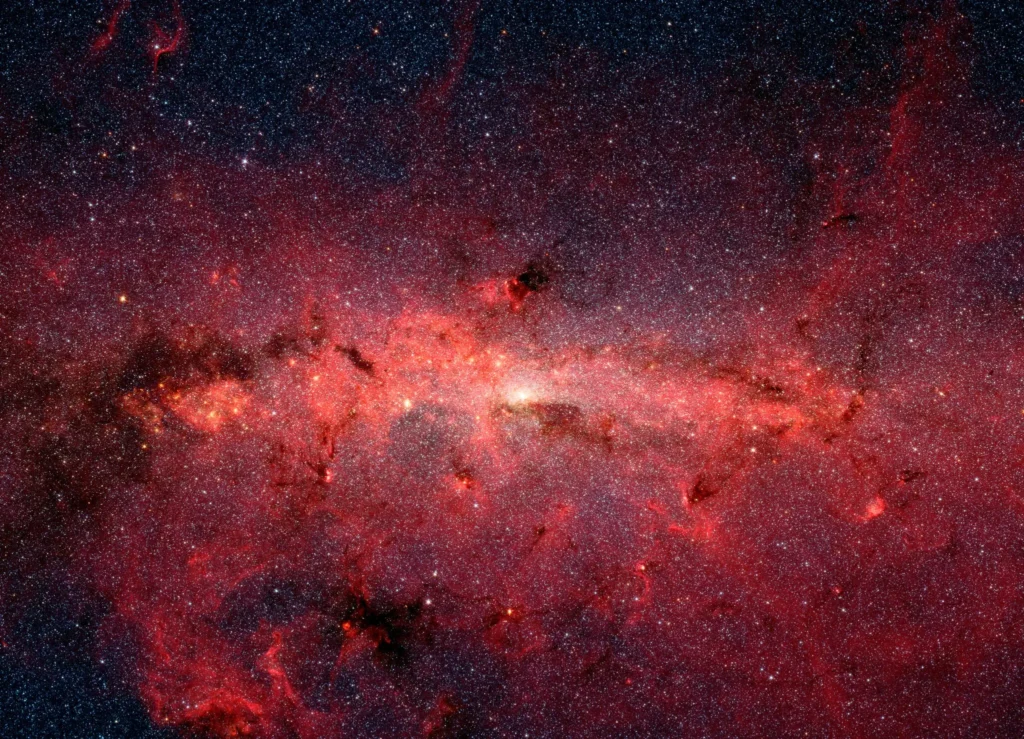
Good news for those of us with a penchant for sweets and space: astronomers have detected an actual sugar molecule drifting through interstellar space—a discovery that strengthens the idea that some of life’s essential ingredients may have formed long before Earth itself.
The finding, reported this week in Nature Astronomy, suggests that the chemistry leading to biology was already underway in the cold clouds between the stars. “This is a real, bona fide sugar,” said Brett McGuire, an astrochemist at MIT who was not involved in the study. “It’s just incredibly exciting.”
Image
The rich life ain’t so expensive!
Conversation
Latest on Into The Impossible
Ten years. One prediction. Two and a half sigma off.
Scott Dodelson, Director of Fermilab’s Cosmic Physics Division, helped build the standard model of cosmology. Now he’s trying to kill it. We get into the Dark Energy Survey result that has him questioning Lambda-CDM, the Dodelson-Widrow mechanism he proposed back in 1994, and why nobody has ever found dark matter in a lab despite decades of searching.
Watch to hear why he told me killing the model he built is his dream, and what cosmology looks like in 2036 if he’s right.
Advertisement

By popular demand, and for my mental health 😳, I am starting a paid “Office Hours” where you all can connect with me for the low price of $19.99 per hour. I get a lot of requests for coffee, to meet with folks one on one, to read people’s Theories of Everything etc. Due to extreme work overload, I’m only able to engage directly with supporters who show an ongoing commitment to dialogue—which is why I host a monthly Zoom session exclusively for patrons in the $19.99/month tier.
It’s also available for paid Members of my Youtube channel at the Cosmic Office Hours level (also $19.99/month). Join here and see you in my office hours!