I nearly ghosted a Pulitzer Prize winner (here's what that arrogance cost me)
M — Musing
Years ago, an email landed in my inbox from someone I didn’t know.
Poetry professor. Wanted to talk about quantum mechanics. Offered to buy me a coffee.
My first reaction was uncharitable.
I can buy my own coffee.
I get a version of this email regularly — someone with a theory, a question, a paper they want me to read, five minutes they want to pick my brain. The offer to buy coffee is usually a politeness, not a negotiation. And I was, at that moment, a busy physicist with a full calendar and a clear sense of which conversations were worth having.
I almost didn’t reply.
Then I noticed she had won the Pulitzer Prize.
Not for physics. For poetry. Which, if I’m being honest, didn’t immediately change my calculus — poetry and quantum mechanics occupy different epistemic neighborhoods. One trades in compression and ambiguity. The other in testable prediction.
Or so I believed.
I agreed to meet.
Assumptions vs. reality
The conversation didn’t unfold the way I expected.
She wasn’t trying to understand the math.
She was trying to understand what the math feels like — how physicists live with uncertainty, probability, superposition. What it means to describe reality with symbols that resist ordinary language.
It was a different vector of inquiry.
Not less rigorous — just orthogonal.
We talked about measurement, indeterminacy, the strangeness of observation shaping outcome. She translated ideas I usually express in equations into compression, metaphor, rhythm.
I realized something subtle:
Physics reduces the universe to its most economical description.
Poetry attempts the same for experience — with the additional constraint that the description must be felt, not just verified.
I’m not sure which is harder.
The part I almost missed
In 2014, Rae Armantrout went on to teach a course called Poetry for Physicists — a title that would have sounded implausible to the earlier version of me who nearly ignored her email.It was (and sadly remains) the only time a UCSD course was offered in both Literature and Physics Departments.
Later, one of her poems &mdash Accounts— sparked, improbably, by that coffee meeting — was selected for Best American Poetry of 2012 … and she dedicated it to me!
I sometimes think about the thin contingency there.
A few seconds of impatience, and that entire chain of events disappears from my personal universe. No conversation. No course. No poem.
From my perspective, it would have vanished without a trace — because the most significant missed opportunities leave no observable signal.
They look exactly like nothing.
A recurring pattern
This is the unsettling part.
The near-miss didn’t feel dramatic at the time.
It felt ordinary. Efficient. Reasonable.
That’s how cognitive filters work.
They protect attention by discarding what seems low-value.
But filters optimized for survival aren’t optimized for discovery.
In physics, the breakthroughs hide in anomalies — the data points you’re tempted to throw away.
In life, they often arrive as emails you almost ignore.
The mirror I didn’t expect
I think about Rae Armantrout’s email when I read the messages I now receive from people who want five minutes and offer to buy me coffee.
My instinct is the same as it was then.
Busy. Full calendar. Low prior probability that this particular conversation will go anywhere.
I haven’t solved the cognitive filter problem. I’ve just become the physicist on the other side of it.
Which is why I now hold office hours at $1,000 per hour — every dollar to charity — not as a revenue mechanism but as an epistemological one. If you’re willing to put real skin in the game, I’ll take the meeting as seriously as I should have taken Rae Armantrout’s email the first time I read it.
The price buys a lot of coffee.
More importantly, it removes my judgment from the equation — which, as it turns out, is the variable most in need of calibration.
The uncomfortable implication
I’ve almost certainly already declined the conversation that would have mattered most. So have you. The counterfactual is permanently inaccessible. The experiment cannot be rerun.
The wavefunction collapsed, and neither of us was measuring.
That’s not a reason for paralysis. It’s a reason to treat your own cognitive filters with the same skepticism you’d apply to a measurement instrument you haven’t calibrated.
Notice the instant a quiet dismissal forms. Then ask once:
What discovery am I about to filter out?
Most of the time, nothing important happens.
But occasionally someone offers to buy you a coffee, and the universe gets slightly larger because you said yes.
Until next time, have a M.A.G.I.C. Week,
Brian
Appearance
IN-DEPTH: Focus Like a Nobel Prize Winner (w/ Brian Keating)
Deep Questions with Cal Newport — September 25, 2025
In this episode, Cal is joined by Dr. Brian Keating, the Chancellor’s Distinguished Professor of Physics at UCSD. They discuss Brian’s book “Focus Like a Nobel Prize Winner,” the nature of ambition, and how to cultivate deep focus in a world of distraction.
Genius
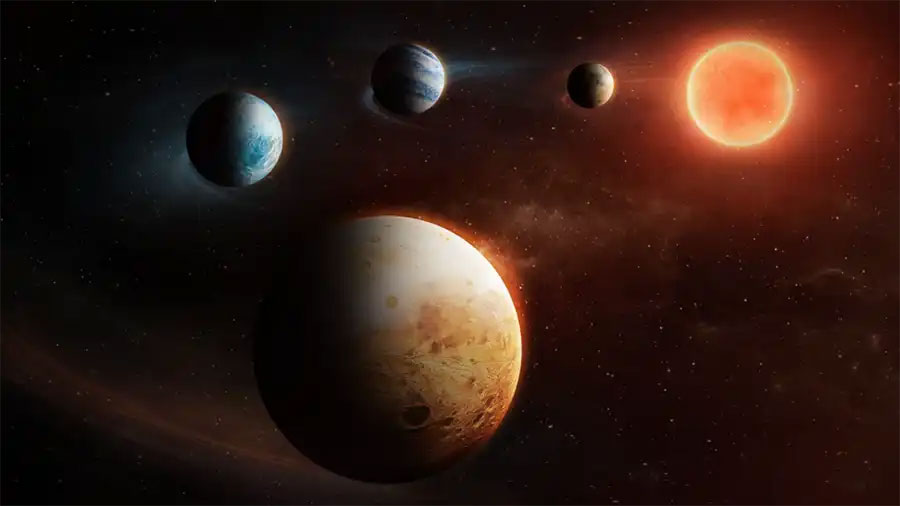
A Solar System That Shouldn’t Exist
Our leading theory of planet formation has a simple rule: rocky worlds form close to their star, gas giants form far out. It’s the pattern we see in our own solar system, and it’s held up — until now.
Astronomers have discovered a bizarre “inside-out” system 116 light-years away, orbiting the red dwarf LHS 1903. Gas giants sit close in, while a rocky planet occupies the cold outer reaches — exactly backwards from everything we expect. This single system challenges the foundational model of how planets are born, suggesting the universe has more than one playbook.
Our rules, it turns out, are just suggestions.
Image
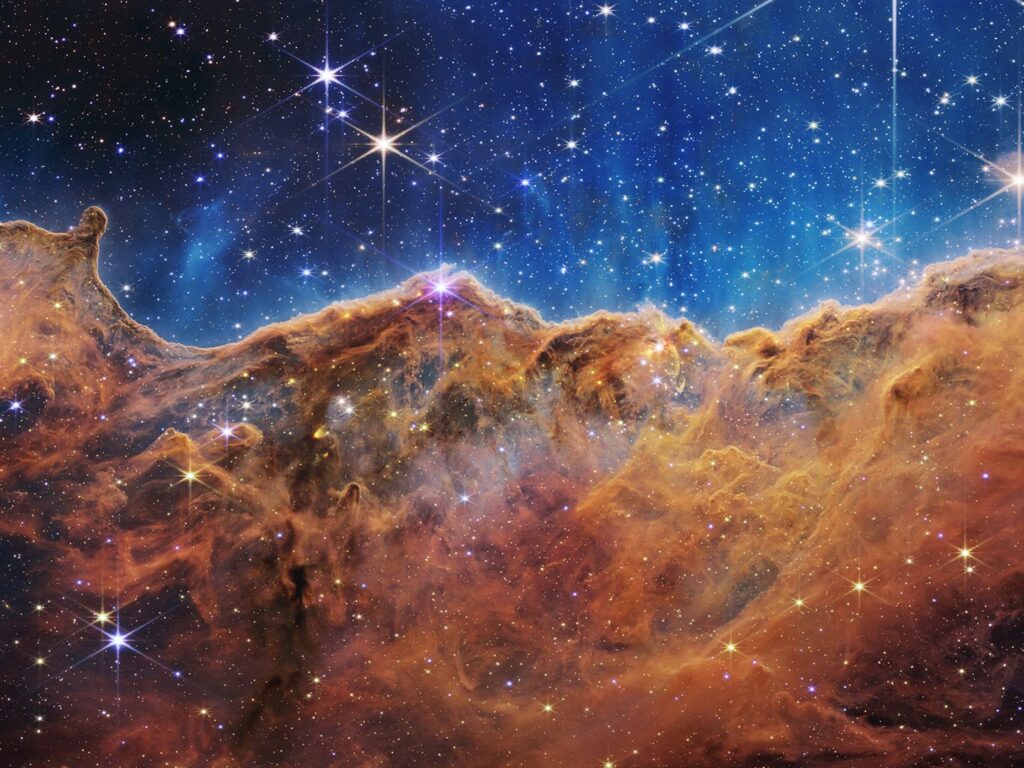
The Cosmic Cliffs of the Carina Nebula, captured by the James Webb Space Telescope. A stellar nursery where the universe writes its own poetry in gas and dust.
Conversation
Can You Find God in the Laws of Physics? This is World!
I explore the provocative question of whether God can be found in the laws of physics — where cosmology, quantum mechanics, and metaphysics converge in ways that challenge both believers and skeptics.
Advertisement
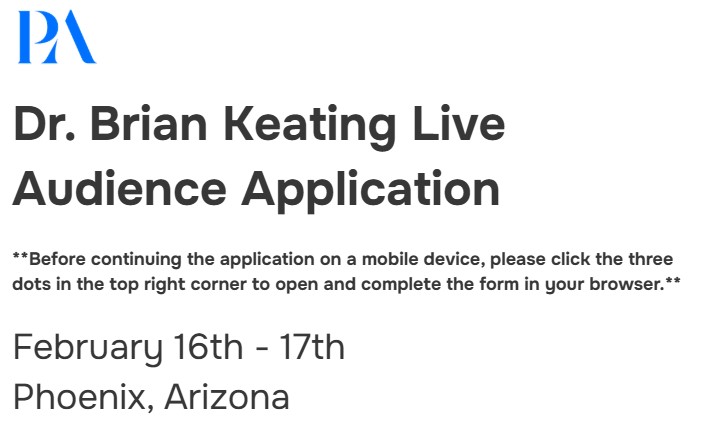
Join me for a free course on black holes in two weeks in Phoenix, AZ!
Submit your application link: https://keating.paperform.co/
You’ll be part of a live audience for your course recording. You’ll also receive 1-year access to the Peterson Academy platform.
If you can’t make it, you can take both of my PA courses — Intro to Astronomy and Intro to Cosmology, which are now available!
Join me on a 9-hour captivating journey through the cosmos, exploring its vastness, the tools used to unravel its mysteries and the groundbreaking discoveries that have shaped our understanding of the universe. We examine the evidence for an expanding universe, the forces driving its evolution, and the cosmic fossils that shed light on its distant past and future.
The course also delves into the enigmatic concepts of dark matter and dark energy, their roles in the universe’s structure and fate, and the ongoing efforts to unravel these cosmic mysteries.
Enroll now for immediate access at https://petersonacademy.com/?utm_source=Keating
Advertisement

By popular demand, and for my mental health 😳, I am starting a paid “Office Hours” where you all can connect with me for the low price of $19.99 per hour. I get a lot of requests for coffee, to meet with folks one on one, to read people’s Theories of Everything etc. Due to extreme work overload, I’m only able to engage directly with supporters who show an ongoing commitment to dialogue—which is why I host a monthly Zoom session exclusively for patrons in the $19.99/month tier.
It’s also available for paid Members of my Youtube channel at the Cosmic Office Hours level (also $19.99/month). Join here and see you in my office hours!