Why I’m Repeating Myself (On Purpose)
Dear Magicians,
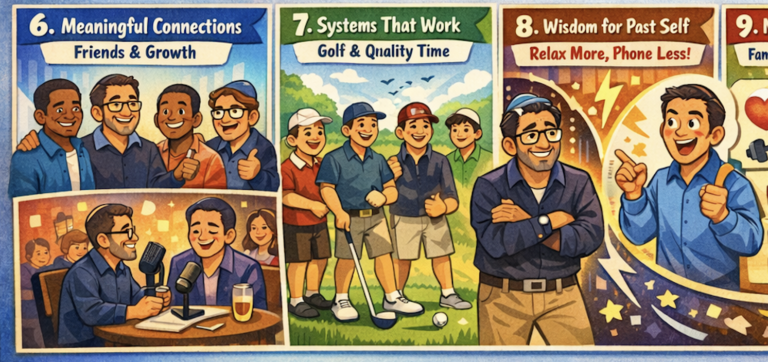
This week begins a short experiment in something I argued for explicitly in Focus Like a Nobel Prize Winner: spaced repetition. Not the flashcard kind, but the kind that actually changes how you think. The goal isn’t novelty. It’s signal reinforcement. Insight doesn’t stick because it’s clever; it sticks because it’s revisited under slightly different lighting. I’ve been doing this in my personal life — a weekly review each Sunday night that you can try for free here. I take a brain dump from my notes and import it into Nano Banana with a prompt to review it and make a cartoon about my week. Part of last week’s review and image is shown above 😀.
So over the next three Mondays, I’m revisiting ideas from 2025’s top conversations on The INTO THE IMPOSSIBLE Podcast — not to summarize them, but to compress what survived reflection. Think of this as intellectual weight training: fewer reps, heavier meaning, better form. If you’ve ever finished a great conversation only to realize a week later that none of it changed how you think, this is my attempt to fix that — starting with myself.
Two small asks, if this resonates:
1️⃣ If Focus Like a Nobel Prize Winner helped sharpen how you think or work, I’d deeply appreciate a short review: https://a.co/d/hi50U9U
I have only received 34 of them for this book, vs. hundreds for my previous books… this gives me a bit of the 😥
2️⃣ Reply to this email with one idea you think is worth repeating until it actually sticks. I read every one (even if I can’t reply to them!)
Repetition Is How Insight Becomes Instinct
Most people confuse learning with exposure. Exposure fades. Insight only compounds when it’s revisited, reframed, and stress-tested over time. That’s why elite performers — including scientists — don’t just move forward. They loop back.
This is the first pass in a short, deliberate repetition cycle. In Focus Like a Nobel Prize Winner, I argue that spaced repetition is how ideas migrate from working memory into instinct. You stop remembering them and start using them. That’s when thinking actually changes behavior.
If this feels slower than the internet’s usual dopamine tempo, that’s intentional. Depth has a longer half-life than novelty.
We like to imagine science advancing through brilliant ideas. Whiteboards. Coffee. A genius squinting heroically. In practice, science advances through better instruments — and the slow, slightly humiliating realization that our previous ideas were incomplete.
Or wrong.
Often wrong.
I say this as someone very fond of theories, guesses, and ideas. Tragically so.
Talking with Kyle made something uncomfortably clear: cosmology doesn’t move forward because theorists have inspired afternoons. It moves forward because the hardware gets better, the teams get bigger, the observations get crisper.
Error bars do more intellectual work than epiphanies. Reality does the grading. We don’t get to appeal the score.
For example, when telescopes improve sensitivity, entire models quietly die — not with drama, but with a revised plot and smaller confidence intervals.
Like when a new instrument shrinks an uncertainty by half and suddenly your favorite theory needs therapy.
Not glamorous.
But decisive.
Niayesh clarified something that should be obvious, yet rarely is: many Big Bang debates aren’t really about data. They’re arguments about priors. Two smart people can look at the same evidence and disagree forever because they never agreed on the rules of the game. For example, one person assumes inflation is the default, such as a starting axiom, while another treats it like a suspect that needs an alibi. Same data. Different conclusions.
It’s like two detectives examining the same crime scene. One assumes it was an accident unless proven otherwise. The other assumes foul play unless ruled out. They catalog the same fingerprints, timelines, and motives — and reach opposite conclusions, not because the evidence differs, but because their starting assumptions do.
No amount of new data fixes a disagreement about assumptions you refuse to name.
Awkward.
Fred reframed fine-tuning in a way I found bracing — and mildly insulting to human ego. The universe doesn’t roll out the red carpet for complexity. It tolerates it. Briefly. Under strict conditions. With no customer support. Life exists in narrow windows carved out by constraint, not cosmic generosity.
For example, change the strength of gravity slightly and galaxies never form.
Or tweak nuclear physics just a bit, like adjusting a recipe, and you get a universe full of disappointment instead of stars.
This is not a universe trying to help us.
It’s a universe barely putting up with us.
Which, honestly, feels about right.
Until next time, have a M.A.G.I.C. Week,
Brian
Appearance
“I was on Matt’s podcast last week. Please do NOT listen to the embarrassing intro which Matt wrote in consultation with my Mom.”
Genius
I need help with a survey from you my genius audience!
Surveys help me improve the podcast and this newsletter too. I treasure each reply and you can win a $100 Amazon gift card.
Unlike meteorites, I can send these cards anywhere on earth!
Image

Check out this incredible gallery of cosmic wonders, catapulting us out to see the cosmic perspective
📸 Marcella Giulia Pace/APOTY25
Conversation
Join me and Harvard astrophysicist Avi Loeb for the final verdict on the interstellar object 3I/ATLAS, the third confirmed visitor from beyond our solar system.
We examine the newly proposed 14th anomaly: the remarkably rare alignment of 3I/ATLAS’s rotation axis within about 8 degrees of the sunward direction at distances greater than 5 AU, a configuration with a probability of less than about 0.5 percent if random.
We lay out the data, compare competing interpretations, and ask the central question: is 3I/ATLAS simply an unusual comet, or something fundamentally different?
SPONSORED BY ALIGNERR

Snipd is my favorite podcast player, but it’s so much more. Snipd’s AI-powered app helps users save and remember great podcast ideas with a tap of their headphones. While most audio platforms focus on passive listening, Snipd caters to those who listen to learn. Users can create personal knowledge libraries from podcasts, audiobooks, and other audio content, and receive personalized content recommendations to expand their “idea space.” I use it every day!
Try it here: get.snipd.com/Cx7S/brian
Advertisement

By popular demand, and for my mental health 😳, I am starting a paid “Office Hours” where you all can connect with me for the low price of $19.99 per hour. I get a lot of requests for coffee, to meet with folks one on one, to read people’s Theories of Everything etc. Due to extreme work overload, I’m only able to engage directly with supporters who show an ongoing commitment to dialogue—which is why I host a monthly Zoom session exclusively for patrons in the $19.99/month tier.
It’s also available for paid Members of my Youtube channel at the Cosmic Office Hours level (also $19.99/month). Join here and see you in my office hours!
Upcoming Episode
Aswath Damodaran will be on The INTO THE IMPOSSIBLE Podcast soon.
He’s the world’s most influential voice on valuation—famous for cutting through hype, narratives, and spreadsheets alike to ask what an asset is actually worth, whether it’s a startup, Big Tech, crypto, or a market bubble.
What should I ask him about markets, AI, investing, bubbles, or how stories distort prices?
Submit your questions here!