The Physics Nobel Is Always Late. That's the Design.
Dear Magicians,
You think you’re underappreciated? Let me tell you about Arnold Sommerfeld. He was nominated for the Nobel Prize in Physics 84 [!] times between 1917 and 1951. Spoiler alert: he never won.
0 for 84.
Even the Padres don’t have a record that bad. Not yet, at least (Go Pads!)
If one of the most nominated physicists in the archive can lose that many times in a row, then the forecasts you’ll see this week (mine included) deserve roughly the confidence of a weather report for the year 2093.
On Tuesday, October 6, at 11:45 CEST at the earliest (2:45 AM in San Diego, where I’ll be awake and pretending to be calm), the Royal Swedish Academy of Sciences will read out a citation. It takes about a minute. The process behind that minute started more than a year ago.
Here is the machinery, from the Academy’s own description and from my experience in two nomination periods. Nomination is by invitation only. In September of the year before, the Nobel Committee for Physics sends confidential forms to thousands of qualified nominators: Academy members, past physics laureates, and professors at universities the Academy selects. You cannot nominate yourself. I’ve checked. Nominations close on January 31. The committee screens the names and picks preliminary candidates, then, from March to May, sends their work to outside experts for assessment. Over the summer it writes a report with its recommendation, signed by every member. In September the Physics Class of the Academy discusses it twice, and can change it. In early October, the full Academy votes by simple majority. The decision is final, with no appeal.
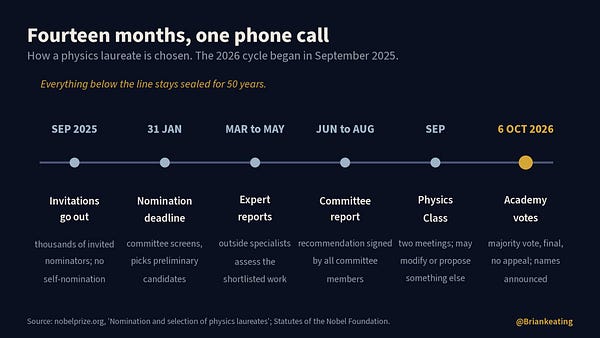
Then comes the part I find delicious as an amateur historian and maddening as a scientist. Everything (the nominees, the nominators, the expert reports, the arguments) is sealed for 50 years.
Longer than the JFK files. Longer than “Disclosure.”
We know about Sommerfeld’s 84 nominations only because his era’s files have been opened. Whatever was argued about this year’s winner stays locked away until 2076. Anyone telling you on Tuesday what the committee “really thought” is writing fan fiction.
Two rules shape the outcome more than any rumor does. A prize can go to at most three people, and it can honor at most two separate works. Since 1974 the prize cannot be given posthumously, unless the laureate dies after the announcement. Physics is now a team sport, with collaborations of hundreds or thousands, and the rule of three keeps colliding with it. The dead-laureate rule is colder still. It quietly removes people from the board every year.
Now the lag. In 2014, Santo Fortunato and colleagues published a short, alarming note in Nature titled “Growing time lag threatens Nobels.” Before 1940, they found, only about 11 percent of physics prizes came more than 20 years after the discovery. Since 1985, about 60 percent have.
I wanted to see that with my own eyes, so I built the charts below with the help of ChatGPT, though the originals in Losing the Nobel Prize were made 4 years before ChatGPT was even a twinkle in Sam Altman’s eye. Disclaimer: these charts were made for social media, not for publication. Do your own due diligence, as I’m known to make mistakes, especially around the Nobel Prize. And even someone obsessed with the Prize like me has his limits on the amount of time and ink I’m willing to devote to this topic. So this is just illustrative, for your entertainment and mine.
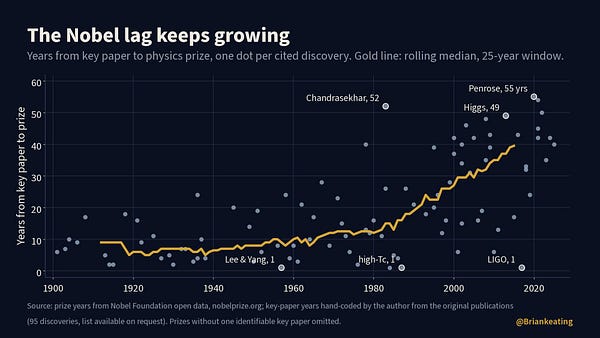
For 95 discoveries cited by physics prizes since 1901, I hand-coded the year of the key paper from the original publications and subtracted it from the prize year. (I left out prizes with no single identifiable key paper. Errors, omissions, and spicy takes are all mine. You get what you pay for, and this newsletter is free, right lol.)
The early prizes were almost news coverage. Röntgen found X-rays in 1895 and won the first physics Nobel in 1901. Today the prize reads more like an obituary written while the subject is still alive. Peter Higgs and François Englert waited 49 years. Roger Penrose’s 1965 black hole theorem won in 2020, 55 years on. Subrahmanyan Chandrasekhar’s limit took 52. Last year’s prize to John Clarke, Michel Devoret and John Martinis honored experiments published in 1985. In my set, the median wait for prizes awarded since 2000 is 38 years.
Exceptions exist, and they’re instructive. High-temperature superconductivity went from paper (1986) to prize (1987) in a single year. LIGO’s gravitational wave detection, published in 2016, won in 2017. Graphene took six years. Speed happens when a result is so clean that nobody needs a decade of follow-up to be sure it isn’t dust. I mention dust for a reason, which I’ll come to.
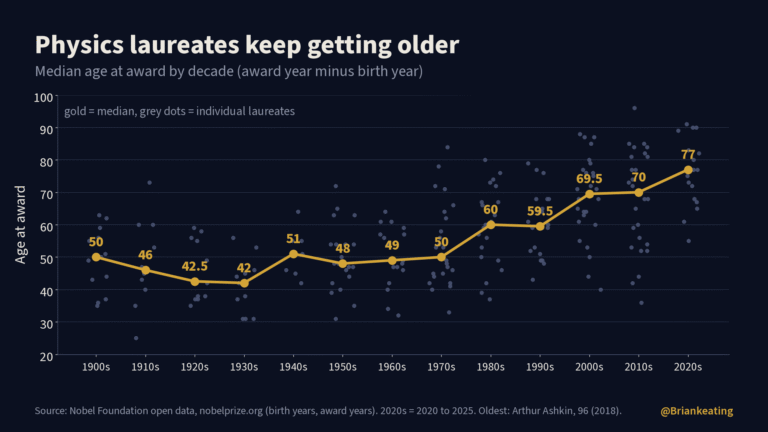
Using the Nobel Foundation’s own data (award year minus birth year), the median age of physics laureates in the 1920s and 1930s was about 42. By the 1980s it was 60, by the 2000s about 70, and for the prizes from 2020 to 2025 it’s 77. Lawrence Bragg won at 25 in 1915. Arthur Ashkin won at 96 in 2018. John Hopfield was 91 in 2024. With the posthumous ban in place, the lag stops being a statistical curiosity and becomes a race against actuarial tables.
Why so slow? The generous reading is that the committee has been burned. Physics has a long tradition of spectacular results that later dissolved, and the committee would rather be late than wrong. Still, there are striking examples. Gustaf Dalén won in 1912 for automatic gas regulators used in buoys and lighthouses, seven years after Einstein’s miraculous year, when he published no fewer than four Nobel-quality results. Maybe you use gas regulators to navigate your sloop, but I sure don’t.
Einstein wouldn’t win until 1921, and received the prize in 1922, for reasons I still don’t understand.
A less generous reading is that the backlog keeps growing. The number of deserving discoveries keeps climbing while the prize still has three seats a year, something Alfred would be puzzled to learn about, as his original prize requirements confined it to a single “person” for work “during the preceding year” only.
I have personal reasons to respect the cautious reading. In 2014, BICEP2, the successor to the BICEP telescope I helped lead and build, announced that it had found the imprint of gravitational waves from the birth of the universe.
For a few weeks it looked like a Nobel was in the bag. It turned out the signal could be explained by dust in our own galaxy. I wrote a whole book about it, Losing the Nobel Prize, and the title is a double entendre, as the French say, not a metaphor. One lesson I took from it: a committee that waits 40 years will rarely be fooled by dust.
So when Tuesday’s names appear, the right question is “what did they do around 1985?” Ask it before “what did they do lately?”
Next time, I’ll put this year’s contenders on one board, with a source of every prediction and the strongest objection to each. The board looks quite different from the one people were passing around last year.
I have spent more time studying how this prize works than any person who hasn’t won it probably should. That obsession became a book, Losing the Nobel Prize. It’s the story of a telescope descended from mine that thought it had caught the universe being born and had actually caught dust. It’s also my case for why the prize itself needs fixing. If you enjoy watching a cosmologist learn humility in public, it’s here (affiliate link).
If you’d rather hear from people who actually won, read my books with interviews with 18 of them: Focus Like a Nobel Prize Winner and Think Like a Nobel Prize Winner. And watch my conversations with 27 Nobel laureates in one playlist. They’re all far more gracious about it than I would be.
Until next time, have a M.A.G.I.C. week.
Brian
Appearance
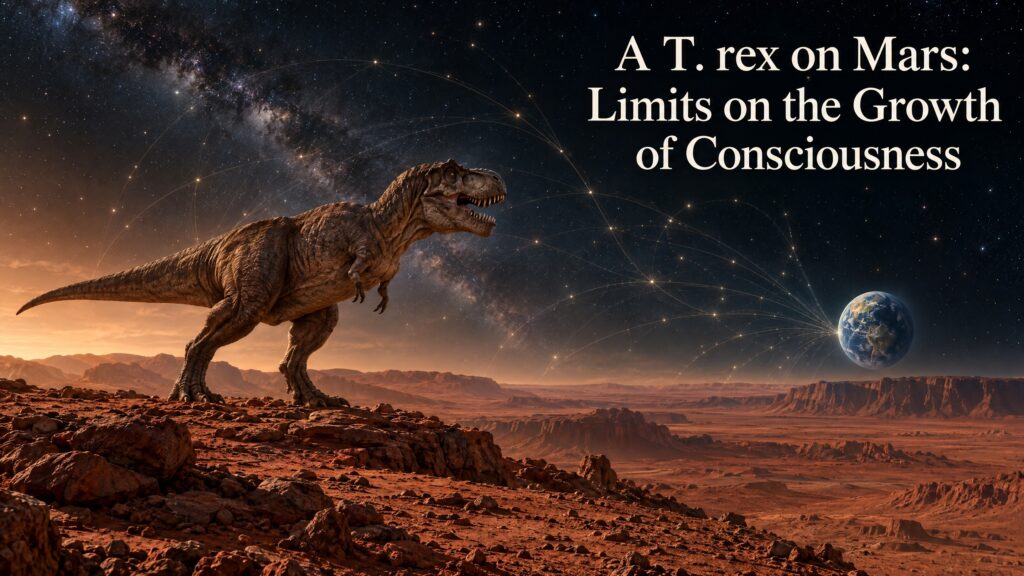
On Thursday, October 15, I’ll give a plenary talk at The Science of Consciousness 2026 called “A T. rex on Mars: Limits on the Growth of Consciousness.” Instead of asking whether life exists out there, I’ll ask a more physical question: once life capable of intelligence gets started, what limits how far it can spread? Using Earth and Mars as a worked example, I’ll build a Drake-equation-style framework for how life and minds move between worlds, survive, and grow. The bottlenecks include energy, evolutionary time, communication delays, and the speed limit on everything from organisms to information. The question I most want to answer is how much of the universe consciousness could ever occupy, and which of those limits are truly fundamental. You can read the abstract here.
Genius
The Extra-Time Paradox
Elite colleges admit the students least likely to struggle, yet they have the most students registered as disabled. In The Atlantic, Rose Horowitch reports that 38 percent of Stanford undergraduates are registered with a disability, 34 percent at Amherst, and more than 20 percent at Brown and Harvard. At public two-year colleges, 3 to 4 percent of students receive accommodations. The most common and most contested one is extra time on exams. For a student with a real disability, it levels the field. For anyone else, it is a head start. Help granted on a low bar of proof, through a process that costs money to navigate, selects for whoever knows how to ask. That is systems design, not cynicism.
When did you last benefit from a system designed to help people less fortunate than you? Worth naming.
A wheelchair ramp is hard to game. A stopwatch is not.
Horowitch, “Accommodation Nation,” The Atlantic (Jan 2026) | A rebuttal from AHEAD
Image
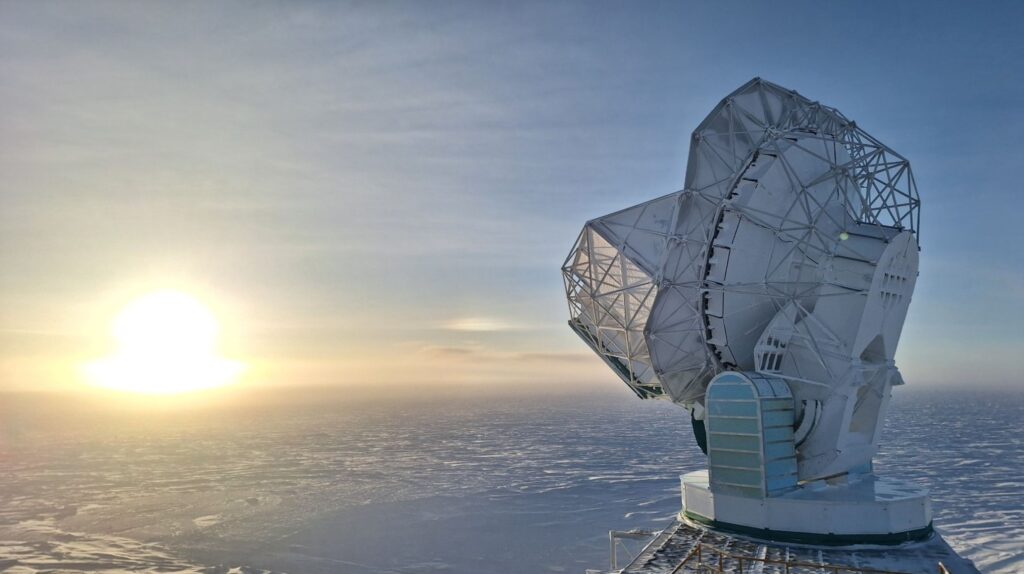
A view you only see if you’ve been at the South Pole since February… It’s a view I never saw, because I even think New York City is too confining sometimes!
Conversation
Latest on Into The Impossible
AI is a design choice, not destiny
Daron Acemoglu shared the 2024 Nobel Prize in Economic Sciences, and he thinks AI’s real productivity gain is an order of magnitude smaller than the industry claims. The bigger danger, he argues, isn’t the machine. It’s that a handful of people are deciding how it gets built. We start with whether science can survive without democracy and why a Nobel chemist left Berkeley for China. Then we get into the optimal amount of heresy science should tolerate, the one rule that would end algorithmic outrage without censoring anyone, and the accounting trick behind billionaire wealth.
As he puts it, “We are still a democracy. Perhaps not for long.”
Audio is live on Apple Podcasts and at briankeating.com/podcast.
Advertisement
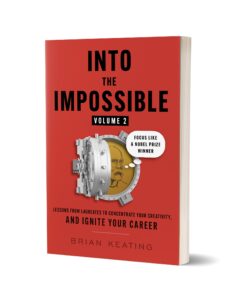
Tomorrow’s prize goes to a discovery made decades ago. Here’s how the winners made it: Focus Like a Nobel Prize Winner!
In Into the Impossible, Volume 2, I sat down with Nobel Prize winners to find out how they actually work: how they protect their attention, pick problems worth decades of their lives, and keep going when nobody else believes the result. Their answers are full of practical lessons you can use to concentrate your creativity and ignite your career, whether or not Stockholm ever calls.
Get your copy on Amazon and learn from the laureates themselves.