The tape recorders are back in my classroom
Dear Magicians,
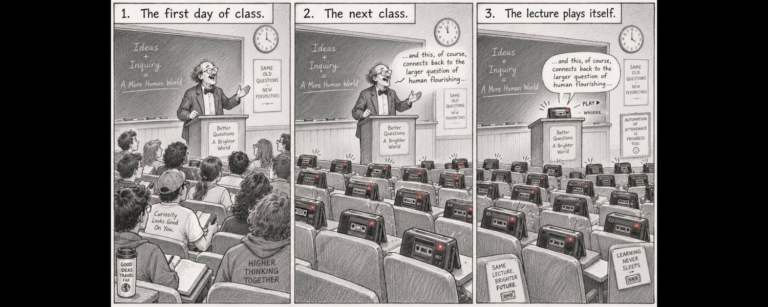
When I was in college in the 1990s, our student newspaper ran a cartoon I still think about.
Panel one: the first day of class. A professor stands at the front of a packed lecture hall. Rows of students stare up at him.
Panel two: the next class. The professor is still there. The students are gone. On every seat sits a cassette tape recorder, red light on, catching every word.
Panel three: the professor is gone too. A tape recorder at the lectern plays his lecture to a room full of tape recorders.
We laughed. It was absurd. Nobody would pay tuition for that.
Classes started at UC San Diego last week. I walked into my first lecture of the quarter and looked out at the room. The tape recorders are back. They are thinner now, and they talk back. My students no longer sneak peeks at Instagram during class. They sneak peeks at an AI. Some are asking it to explain what I said a minute ago. Some are asking it to do a problem set I have not assigned yet.
I use these tools every day. I am not here to scold anyone. A tutor that never gets tired is a gift to the kid who is too shy to raise a hand. I would have loved to take a class from Albert Einstein. I can’t. But I own his collected papers, and a machine can now read every page of them before I finish my coffee.
Here is what bothers me. The cartoon was never about technology. It was about a deal. The student pretends to learn. The professor pretends to teach. The university sends the bill. The tape recorder only made the deal visible.
For centuries, the university sold something scarce: information, locked in a room, delivered by one person at a set time. That scarcity is gone. If what a college sells is information, the product is now free. At a private school, the price tag for it can top a quarter of a million dollars.
So what is left worth paying for? The things a recorder cannot catch.
The question a student asks in office hours that she would never type into a chat window. The look on a room full of faces that tells me the whole room got lost at step three. The moment I tell someone I respect, “That’s wrong,” and they come back a week later with something better. I go to my graduate students’ weddings. No chatbot has ever been invited to one.
The rabbis saw this two thousand years ago. Pirkei Avot says, “Aseh lecha rav.” Make for yourself a teacher. Not find a teacher. Not buy one. Make one. You make a teacher by showing up with your own confusion and letting another human being wrestle with it beside you.
The Talmud also records Rabbi Chanina admitting what every good professor knows: I learned much from my teachers, more from my colleagues, and the most from my students.
That is the part the cartoon missed. Teaching is not a broadcast. It runs both ways. A tape recorder can play my lecture forever. It will never teach me anything back.
So this quarter I am offering my students a new deal. Use the machine. Argue with it. Check it. Then come to my office and argue with me. I promise to be harder to flatter.
Until next time, have a M.A.G.I.C. week.
Brian
Appearance
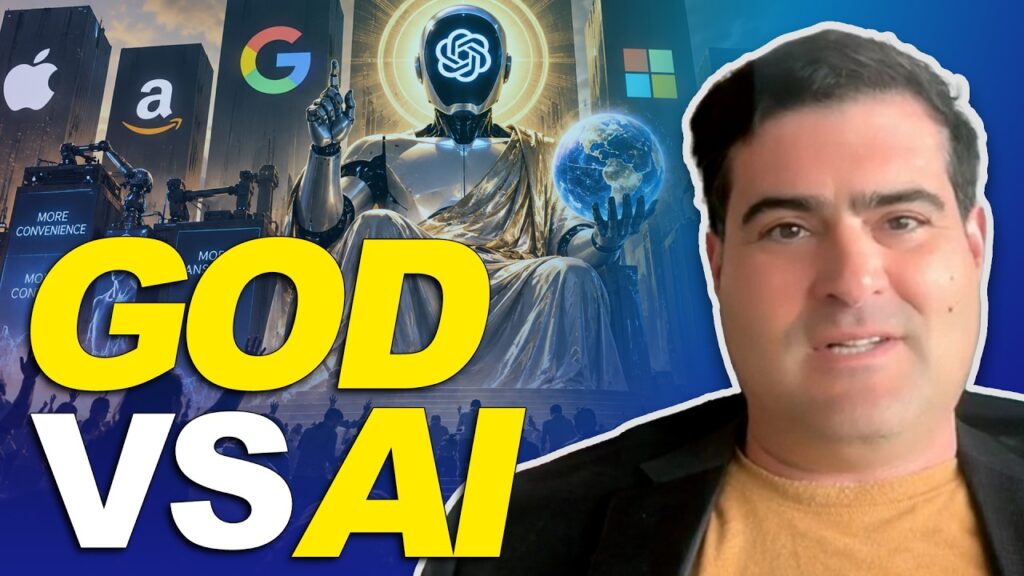
Is Big Tech trying to replace God with AI?
Mike Slater invited me onto Politics By Faith on The First to take on that question, and I started with the Tower of Babel. The Hebrew text never mentions the tower without the city that built it: the technology and the crowd that worships it arrive together. We got into why AI is a double-edged sword (I am still waiting for someone to sell me the single-edged kind that only does good), what Dario Amodei’s name means in Latin, and why I tell people to keep their medical and financial secrets out of the cloud and run local models instead. I also told the tape-recorder cartoon from this week’s Musing, and explained why no model can write the Brandenburg Concertos or the Torah from scratch. It needs us, and it needs prophets.
Genius
Pronoia
Paranoia is the irrational belief that the universe is conspiring against you. Its logical complement barely has a name: pronoia, the belief that the world is conspiring in your favor. Sociologist Fred Goldner of Queens College put the word into print in 1982, and it has since grown into a habit of mind that reads obstacles as character development and coincidences as support. It sounds delusional, but a mild dose looks adaptive: more resilience, better creative work, and more persistent effort under adversity. The accurate frame and the functional frame are not always the same frame, which is uncomfortable for a scientist whose job is to prefer accuracy.
So try this for one week: read neutral events as favorable, and track whether your accuracy suffers or flourishes.
Paranoids think the world is out to get them. Pronoids think it is out to get them a present.
Image
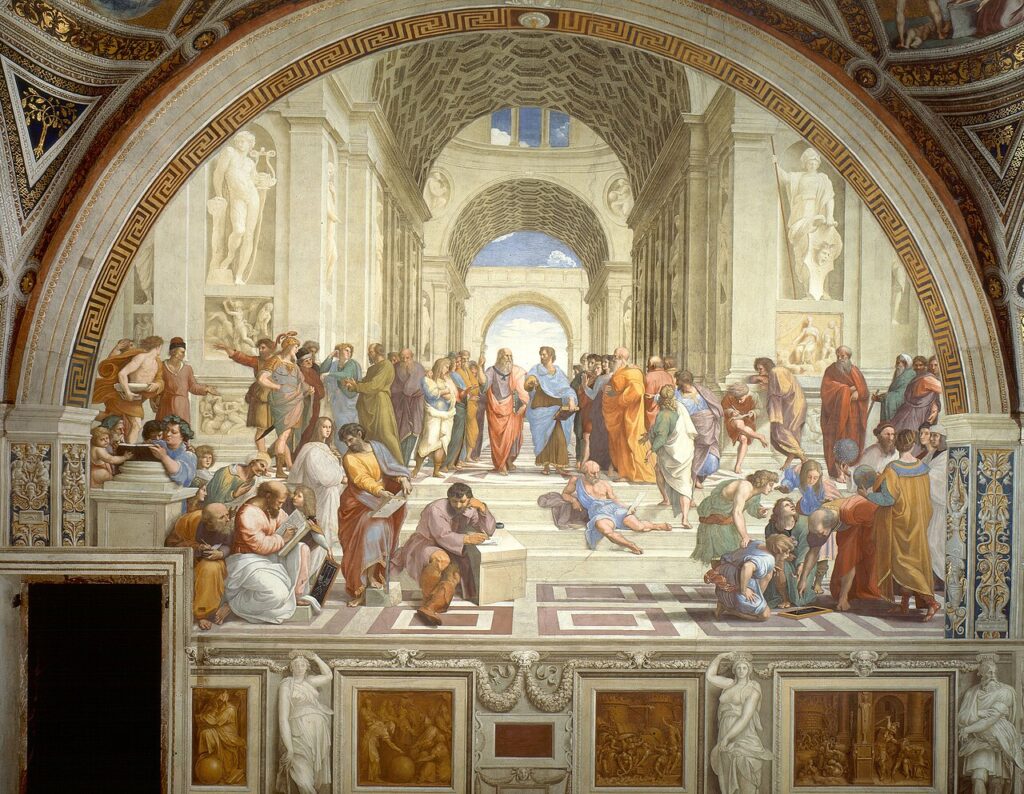
Raphael painted The School of Athens on a Vatican wall between 1509 and 1511. Plato points up. Aristotle points out. Around them, dozens of people are doing the one thing no recorder can do for you: arguing, in person, with someone who cares whether you get it right.
Credit: Raphael, Stanza della Segnatura, Apostolic Palace, Vatican City. Public domain, via Wikimedia Commons.
Conversation
Latest on Into The Impossible
One event in 220 days, and the people who waited for it
Rick Gaitskell spent four years as an investment banker in the 1980s, then walked away to spend four decades hunting something nobody has ever caught. He is a professor at Brown, my alma mater, and a leader of LZ, a detector holding seven tonnes of liquid xenon a mile underground in a former South Dakota gold mine. His team built what he calls the quietest watched place in the known universe, so quiet that radon, the same gas you test for in your basement, counts as a serious enemy.
After 220 days of data they saw one event that could be dark matter, and Rick walks through why an honest collaboration watched a 3.4 sigma hint shrink to 2.6 and said so out loud. The part that stayed with me is human. I tell Rick about a grad student I once met who had been working toward his PhD for nine and a half years. Rick admits that more than 95 percent of research ends in a negative result, and that his group once heard from students who felt set up to fail and concluded they had failed their students.
As Rick puts it, we only get one universe to play with, and nature does not care whether your theory is beautiful.
Audio is live on Apple Podcasts and at briankeating.com/podcast.
Advertisement

By popular demand, and for my mental health 😳, I am starting a paid “Office Hours” where you all can connect with me for the low price of $19.99 per hour. I get a lot of requests for coffee, to meet with folks one on one, to read people’s Theories of Everything etc. Due to extreme work overload, I’m only able to engage directly with supporters who show an ongoing commitment to dialogue—which is why I host a monthly Zoom session exclusively for patrons in the $19.99/month tier.
It’s also available for paid Members of my Youtube channel at the Cosmic Office Hours level (also $19.99/month). Join here and see you in my office hours!